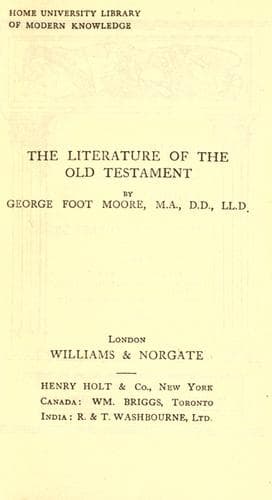
The Literature of the Old TestamentMoore, George Foot
Religion
The Literature of the Old Testament
Moore, George Foot
Bible. Old Testament -- Introductions
It is thus evident that, while there was agreement in general, there
was, down to the second century A.D., no authoritative list of the
"Scriptures," and that about some of the books there were conflicting
opinions among the learned of the most orthodox stamp. An interesting
confirmation of this is the fact that in the first half of that
century it was thought necessary to make a formal deliverance that the
"Gospel and other writings of the heretics" are not Sacred Scripture.
There are other indications that in that generation Jewish
Christianity had a dangerous attraction for some even in rabbinical
circles, and there was evidently ground for apprehension that the
inspiration which the Christians claimed for the Scriptures of the New
Covenant might impose upon well-meaning but uninstructed Jews. In the
same connection it was decided, further, that Ben Sira (Ecclesiasticus)
was not Holy Scripture, and that no books written from his time on (about
200 B.C.) were inspired, in accordance with the theory, found also in
Josephus, that inspiration ceased in the age of Ezra and Nehemiah.
By such decisions, recognizing the inspiration of books that had been
challenged and excluding others for which inspiration had been
claimed, the canon of the Scriptures, that is, the authoritative list
of Sacred Books, was defined. The oldest catalogue we have, containing
the titles of all the books, dates probably from the latter part of
the second century, and is not concerned with the point of
canonicity--which it takes for granted--but with the proper order of
the Prophets and the Scriptures.
The Jews had for centuries been widely distributed through the lands
that had been included in the kingdoms of Alexander's successors.
There were large numbers in Babylonia and the neighbouring provinces
of the Parthian empire, and still more in the countries around the
eastern end of the Mediterranean, in Syria and Asia Minor, in Egypt
and Cyrene. In Alexandria the Jews had a whole quarter of the city to
themselves, and Philo estimates their numbers in Egypt in his time
(ca. A.D. 40) at a million.
Public-domain text, read in full here on John Shaqi.
Reviews
Reviews
No reviews yet
Be the first to share your thoughts on this work.
Join the Discussion
Join the discussion
Sign in to leave a comment or review.
Sign InorCreate an account