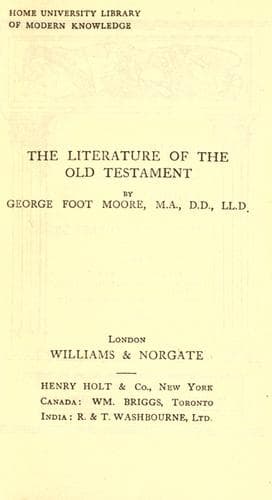
The Literature of the Old TestamentMoore, George Foot
Religion
The Literature of the Old Testament
Moore, George Foot
Bible. Old Testament -- Introductions
The assignment of forty-eight cities to the priests and levites,
including the most important places in the country, is an extravagance
even for the sacerdotal imagination, comparable to Ezekiel's
partition of the land in parallel strips. It is the counterpart of
Num. xxxv. 1-8, in a late supplement to the priestly laws, and
directly contradicts the older principle (Num. xviii. 21-24) that
neither priests nor levites shall have any landed property. Thus in
Joshua, as in the Pentateuch, the priestly element is neither of one
sort nor of one age: and again the evidence of the Greek version shows
that additions and changes continued to be made in the text till the
neighbourhood of 200 B.C.
There is no evidence that the author of our Book of Joshua was the
same as the author of the present Pentateuch; various indications
point rather to the contrary. Nor can the author of the deuteronomist
history of the conquest be certainly identified with any one of the
hands engaged in the compilation and enlargement of the Book of
Deuteronomy; all that can be affirmed is that he was of the same
spirit, and that literary dependence upon Deuteronomy, and sometimes
on younger parts of it, is visible in many places in Joshua.
The Book of Joshua closes with a farewell address by Joshua to the
tribes of Israel assembled at Shechem, in which, after a brief résumé
of God's dealing with their fathers from the calling of Abraham, the
exodus, and their own more recent experiences down to the present, he
exhorts them to put away the gods which their fathers served "beyond
the river" (in Mesopotamia), and worship Jehovah alone. Thereupon the
people solemnly pledge themselves to serve him only and hearken to his
words (Jos. 24). There is no question that this discourse is derived
from E; a counterpart to it from the hand of the author of the
deuteronomist Joshua stands in c. 23, and corresponds to the address
of Moses in Deut. xxxi. 1-8. The sequel of Jos. xxiv. 28 is found in
Judg. ii. 6-9. The restoration at a late time, of the old fragment
Judg. i. 1-36, and the division of the books at this point, led to the
repetition of the verses in Jos. xxiv. 29 ff. The importance of this
fact is the proof it gives that E narrated the history of the
generations following the death of Joshua as an apostasy from the
religion of Jehovah such as the dying leader had warned the people
against (Jos. xxiv. 19), and thus determined the treatment of the
whole period which we now find in the Book of Judges. The last
injunctions of Joshua in the deuteronomist history (Jos. xxiii. 14-16)
exhibit the same conception of the subsequent history; in Judg. ii.
11-iii. 6, both E and the deuteronomist author are represented.
CHAPTER IX
JUDGES
Public-domain text, read in full here on John Shaqi.
Reviews
Reviews
No reviews yet
Be the first to share your thoughts on this work.
Join the Discussion
Join the discussion
Sign in to leave a comment or review.
Sign InorCreate an account