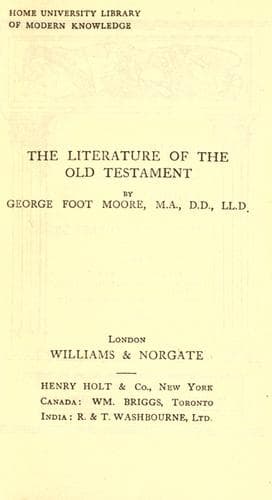
The Literature of the Old TestamentMoore, George Foot
Religion
The Literature of the Old Testament
Moore, George Foot
Bible. Old Testament -- Introductions
The Book of Judges falls into three parts, namely, (1) Judg. i. 1-ii.
5, which intrudes, as has already been observed, between the close of
Joshua and its immediate sequel in Judges ii. 6 ff.; (2) Judg. ii.
6-xvi. 31, stories of a succession of champions and deliverers of
Israel in the centuries preceding the establishment of the kingdom;
(3) Judg. 17-18; 19-21, two additional stories laid in the time of the
Judges. In the Christian Bibles the story of Ruth, which also is said
to have occurred in the days of the Judges, follows.
The introduction, Judg. ii. 6-iii. 6, gives a summary of the whole
period: as soon as Joshua and his generation had passed away, the
Israelites fell away from the religion of Jehovah, and worshipped the
gods of Canaan; indignant at this defection, he allowed them to be
overrun and subdued by their enemies; when in their distress they
turned to their own God for help, he raised them up champions who
delivered them; but their amendment was brief, they presently relapsed
into heathenism; and so it went on from bad to worse. In
correspondence with this general scheme each epoch in the history is
opened in some such way as this: The Israelites again did what was
evil in the sight of Jehovah; he delivered them into the power of
such and such a tyrant or nation; when they cried unto him, he raised
up so and so as a deliverer. Thereupon follows the story of the
deliverance (see iii. 7-11; iii. 12-15; iv. 1 ff.). Sometimes, as in
vi. 1-10, x. 6-18, these preambles are expanded, but the purport
remains the same.
Another feature of the book is the systematic chronology in which the
frequency of the numbers twenty, forty, and eighty (forty years being
in the Old Testament equivalent to a generation) at once strikes the
attention; see iii. 11, 30; iv. 3; v. 31; viii. 28; xiii. 1; xv. 20
(xvi. 31). In several other instances the figures vary a little on
either side of twenty (eighteen, twenty-two, etc.). The duration of
the oppression is given in the introduction of the story; the period
of peace and prosperity which succeeded the deliverance, at the end;
see, e.g., iv. 3; v. 31. In the same way the life of Moses is divided
into three parts of forty years each; Eli judged Israel forty years;
David and Solomon each reigned forty years. It can hardly be doubted
that this chronology is artificial, and that the key to it is found in
1 Kings vi. 1, which reckons four hundred and eighty years (i.e.
twelve generations) from the exodus to the building of Solomon's
temple; but the actual figures in Judges and Samuel do not foot up to
this sum, and there are some gaps in the series, namely, the years of
Joshua after the conquest, the rule of Samuel, and that of Saul. The
symmetry of the scheme has been broken by intrusions or accidental
omissions in the later history of the book.
Public-domain text, read in full here on John Shaqi.
Reviews
Reviews
No reviews yet
Be the first to share your thoughts on this work.
Join the Discussion
Join the discussion
Sign in to leave a comment or review.
Sign InorCreate an account