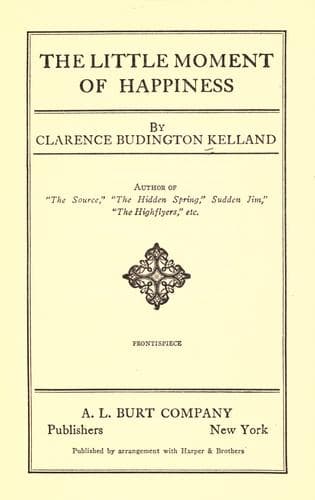
The Little Moment of HappinessKelland, Clarence Budington
General
The Little Moment of Happiness
Kelland, Clarence Budington
Man-woman relationships -- Fiction; World War, 1914-1918 -- Fiction
If love were cruel to Andree, and the man she worshiped unkind, she
would fade silently, withdraw into herself, and suffer; Maude would have
suffered, but she would have faced the matter and held her own. It would
be possible for Maude to go through life alone; that Andree should do so
was utterly unthinkable. This was, perhaps, because Andree thought of
herself only as a woman, and as a woman whose life must be bound up with
the life of some man. Maude Knox thought of herself as an individual, a
distinct entity with rights and purposes which must not be invaded or
interfered with.
A man might expect help, encouragement, even dynamic career from Maude
Knox. He might expect a wonderful fidelity from her. She would take an
interest in his life and would want to have a finger in the shaping of
his destiny. Andree would play her part in his life less obtrusively,
but perhaps as powerfully by keeping alive his love and by lavishing her
love upon him. She would ask nothing, demand nothing except a
continuance of love and a lavishment of tenderness. So long as love
endured she would follow him to the highest success without taking any
great thought of that success, or she would have descended with him to
the depths of failure without bewailing that failure—for success to her
meant but one thing, and that thing was love.
Maude was the ideal wife in a partnership of man and wife as Americans
have come to look upon that relation. The vestibule of the Presbyterian
church would receive Maude with fulsome compliments and would
congratulate Ken upon making a wise selection. Everybody would say that
he had won a splendid wife ... and it would be true. She was a typical
American wife—that is to say, she embodied those things which Americans
have set as their ideals of wifehood.... He wondered what the vestibule
would say of Andree, even granting that Andree’s conception of virtue
were the American conception. He could not imagine, though he could well
imagine the stir she would create. She would be too beautiful—so
beautiful as to excite righteous suspicion. She would be beautiful in a
foreign sort of way, and therefore a sinful sort of way. The vestibule
would never forgive her because she had lived in Paris and because she
did not pronounce English as well as it did—through its nose. They would
never be able to see into her heart nor to understand the marvel of her
goodness.... She was as far outside their experience as she was actually
outside Ken’s experience, who studied her hourly, but never understood
her and never would understand her.... She would always be a mystery and
an anomaly to him. She would always be to him a creature who was guilty
according to his inherited conscience and yet escaped the accusation or
the stain of guilt. She was bad, yet she was wholly good.
Public-domain text, read in full here on John Shaqi.
Reviews
Reviews
No reviews yet
Be the first to share your thoughts on this work.
Elsewhere in the archive
Join the Discussion
Join the discussion
Sign in to leave a comment or review.
Sign InorCreate an account