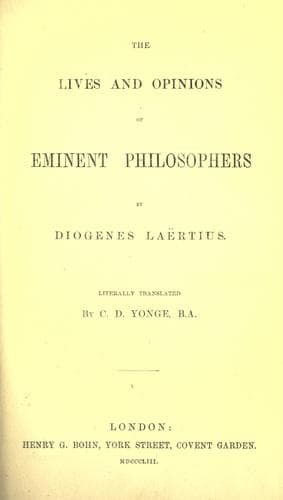
The Lives and Opinions of Eminent PhilosophersDiogenes Laertius
Philosophy
The Lives and Opinions of Eminent Philosophers
Diogenes Laertius
Philosophers, Ancient -- Biography; Philosophy, Ancient
LXX. Of good things there are three kinds; for there are some which can
be possessed; others, which can be shared; others, which one realizes
in one’s self. Those which can be possessed, are those which it is
possible for a person to have, such as justice, or good health; those
can be shared, which it is not possible for a person to have entirely
to himself, but which he may participate in; as for instance, a person
cannot be the sole possessor of abstract good, but he may participate in
it. Those again a person realizes in himself, when they are such, that
he cannot possess them himself, or share them with others, and yet they
ought to exist; as for instance, it is good to be virtuous and just, but
yet a man does not possess the being virtuous, or participate in it;
but the being virtuous and just ought to exist in him. Of good things,
therefore, there are those which are possessed, those which are shared,
and those which ought to exist in a man.
LXXI. In the same manner, good counsel is divisible into three kinds.
For there is one kind which is derived from past time, another from the
future, another from the present. That which is derived from past time is
made up of instances, as for instance what the Lacedæmonians suffered by
trusting to such and such people. That which relates to the present, is
when what is wanted, is to show that the fortifications are weak, the men
cowardly, or the provisions scanty. That which concerns the future, is
when the speaker urges that no injury ought to be offered to ambassadors,
in order that Greece may not get an evil reputation; and supports his
argument by instances. So that good counsel has reference, firstly to
what is past, secondly to what is present, and thirdly to the future.
LXXII. Voice is divided into two parts, one of which is animated, and the
other inanimate. That is animated, which proceeds from living animals,
while sounds and echoes are inanimate. Again, animated voice may be
divided into that which can be indicated by letters, and that which
cannot; that which can be so indicated being the voice of men, and that
which cannot being the voice of animals; so that one kind of voice is
animated, the other inanimate.
Public-domain text, read in full here on John Shaqi.
Reviews
Reviews
No reviews yet
Be the first to share your thoughts on this work.
Elsewhere in the archive
Join the Discussion
Join the discussion
Sign in to leave a comment or review.
Sign InorCreate an account