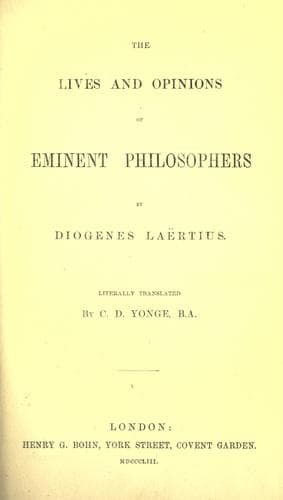
The Lives and Opinions of Eminent PhilosophersDiogenes Laertius
Philosophy
The Lives and Opinions of Eminent Philosophers
Diogenes Laertius
Philosophers, Ancient -- Biography; Philosophy, Ancient
the expenses which I have here set down in my will, as it shall require
to be expended. And when he has done this, then I will that he shall be
discharged of all debts due from him to me or to my estate. And if any
profit shall accrue to him in Chalcis, from property belonging to me,
it shall be all his own. My executors, for all the duties provided for
in this will, shall be Hipparchus, Neleus, Strato, Callinus, Demotimus,
Callisthenes, and Ctesarchus. And this my will is copied out, and all
the copies are sealed with the seal-ring of me, Theophrastus; one copy
is in the hands of Hegesias the son of Hipparchus; the witnesses thereto
are Callippus of Pallene, Philomelus of Euonymus, Lysander of Hybas, and
Philion of Alopece. Another copy is deposited with Olympiodorus, and the
witnesses are the same. A third copy is under the care of Adimantus, and
it was conveyed to him by Androsthenes, his son. The witnesses to that
copy are Arimnestus the son of Cleobulus, Lysistratus of Thasos, the
son of Phidon; Strato of Lampsacus, the son of Arcesilaus; Thesippus of
Cerami, the son of Thesippus; Dioscorides of the banks of the Cephisus,
the son of Dionysius.—This was his will.
XV. Some writers have stated that Erasistratus, the physician, was a
pupil of his; and it is very likely.
LIFE OF STRATO.
I. Theophrastus was succeeded in the presidency of his school by Strato
of Lampsacus, the son of Arcesilaus, of whom he had made mention in his
will.
II. He was a man of great eminence, surnamed the Natural Philosopher,
from his surpassing all men in the diligence with which he applied
himself to the investigation of matters of that nature.
III. He was also the preceptor of Ptolemy Philadelphus, and received from
him, as it is said, eighty talents; and he began to preside over the
school, as Apollodorus tells us in his Chronicles, in the hundred and
twenty-third olympiad, and continued in that post for eighteen years.
IV. There are extant three books of his on Kingly Power; three on
Justice; three on the Gods; three on Beginnings; and one on each of the
subjects of Happiness, Philosophy, Manly Courage, the Vacuum, Heaven,
Spirit, Human Nature, the Generation of Animals, Mixtures, Sleep, Dreams,
Sight, Perception, Pleasure, Colours, Diseases, Judgments, Powers,
Metallic Works, Hunger, and Dimness of Sight, Lightness and Heaviness,
Enthusiasm, Pain, Nourishment and Growth, Animals whose Existence is
Doubted, Fabulous Animals, Causes, a Solution of Doubts, a preface to
Topics; there are, also, treatises on Contingencies, on the Definition,
on the More and Less, on Injustice, on Former and Later, on the Prior
Genus, on Property, on the Future. There are, also, two books called the
Examination of Inventions; the Genuineness of the Commentaries attributed
to him, is doubted. There is a volume of Epistles, which begins thus:
“Strato wishes Arsinoe prosperity.”
Public-domain text, read in full here on John Shaqi.
Reviews
Reviews
No reviews yet
Be the first to share your thoughts on this work.
Elsewhere in the archive
Join the Discussion
Join the discussion
Sign in to leave a comment or review.
Sign InorCreate an account