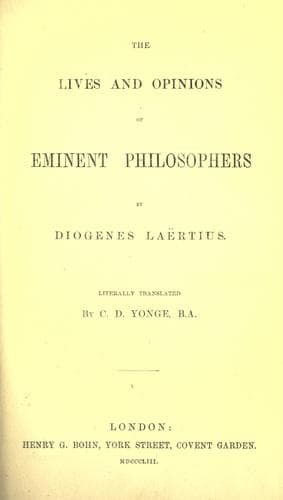
The Lives and Opinions of Eminent PhilosophersDiogenes Laertius
Philosophy
The Lives and Opinions of Eminent Philosophers
Diogenes Laertius
Philosophers, Ancient -- Biography; Philosophy, Ancient
V. And Eubulus says, in his essay entitled, The Sale of Diogenes, that he
taught the children of Xeniades, after their other lessons, to ride, and
shoot, and sling, and dart. And then in the Gymnasium he did not permit
the trainer to exercise them after the fashion of athletes, but exercised
them himself to just the degree sufficient to give them a good colour
and good health. And the boys retained in their memory many sentences
of poets and prose writers, and of Diogenes himself; and he used to
give them a concise statement of everything in order to strengthen
their memory; and at home he used to teach them to wait upon themselves,
contenting themselves with plain food, and drinking water. And he
accustomed them to cut their hair close, and to eschew ornament, and to
go without tunics or shoes, and to keep silent, looking at nothing except
themselves as they walked along. He used, also to take them out hunting;
and they paid the greatest attention and respect to Diogenes himself, and
spoke well of him to their parents.
VI. And the same author affirms, that he grew old in the household of
Xeniades, and that when he died he was buried by his sons. And that while
he was living with him, Xeniades once asked him how he should bury him;
and he said, “On my face;” and when he was asked why, he said, “Because,
in a little while, everything will be turned upside down.” And he said
this because the Macedonians were already attaining power, and becoming
a mighty people from having been very inconsiderable. Once, when a man
had conducted him into a magnificent house, and had told him that he
must not spit, after hawking a little, he spit in his face, saying that
he could not find a worse place. But some tell this story of Aristippus.
Once, he called out, “Holloa, men.” And when some people gathered round
him in consequence, he drove them away with his stick, saying, “I called
men, and not dregs.” This anecdote I have derived from Hecaton, in the
first book of his Apophthegms. They also relate that Alexander said that
if he had not been Alexander, he should have liked to be Diogenes. He
used to call ἀνάπηροι (cripples), not those who were dumb and blind, but
those who had no wallet (πήρα). On one occasion he went half shaved into
an entertainment of young men, as Metrocles tells us in his Apophthegms,
and so was beaten by them. And afterwards he wrote the names of all those
who had beaten him, on a white tablet, and went about with the tablet
round his neck, so as to expose them to insult, as they were generally
condemned and reproached for their conduct.
Public-domain text, read in full here on John Shaqi.
Reviews
Reviews
No reviews yet
Be the first to share your thoughts on this work.
Elsewhere in the archive
Join the Discussion
Join the discussion
Sign in to leave a comment or review.
Sign InorCreate an account