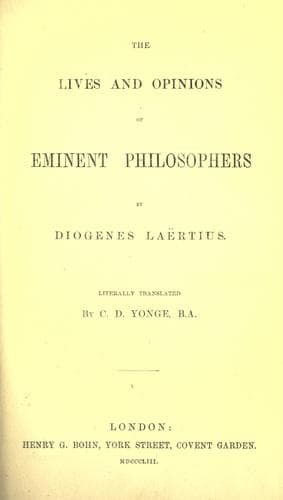
The Lives and Opinions of Eminent PhilosophersDiogenes Laertius
Philosophy
The Lives and Opinions of Eminent Philosophers
Diogenes Laertius
Philosophers, Ancient -- Biography; Philosophy, Ancient
That is a reasonable or probable proposition, which has a great
preponderance of opportunities in favour of its being true; as for
instance, “I shall be alive to-morrow.” And there are other different
kinds of propositions and conversions of them, from true to false, and
re-conversions again; concerning which we must speak at some length.
XLIX. An argument, as Crinis says, is that which is composed of a lemma
or major premiss, an assumption or minor premiss, and a conclusion; as
for instance this, “If it is day, it is light;” “But it is day, therefore
it is light.” For the lemma, or major premiss, is, “If it is day, it is
light.” The assumption, or minor premiss, is, “It is day.” The conclusion
follows, “Therefore it is light.” The mode of a proposition is, as it
were, a figure of an argument, as for instance, such as this, “If it is
the first, it is the second; but it is the first, therefore it is the
second.”
A conditional syllogism is that which is composed of both the preceding
arguments; as for instance, “If Plato is alive, Plato breathes; but the
first fact is so, therefore so is the second.” And this conditional
syllogism has been introduced for the sake, in long and complex
sentences, of not being forced to repeat the assumption, as it was a long
one, and also the conclusion; but of being able, instead, to content
one’s self with summing it up briefly thus, “The first case put is true,
therefore so is the second.”
Of arguments, some are conclusive, others are inconclusive. Those are
inconclusive which are such, that the opposite of the conclusion drawn
in them is not necessarily incompatible with the connection of the
premisses. As for instance, such arguments as these, “If it is day, it
is light; but it is day, therefore, Dion is walking.” But of conclusive
arguments, some are called properly by the kindred name conclusions,
and some are called syllogistic arguments. Those then are syllogistic
which are either such as do not admit of demonstration, or such as are
brought to an indemonstrable conclusion, according to some one or more
propositions; such for instance as the following: “If Dion walks, then
Dion is in motion.” Those are conclusive, which infer their conclusion
specially, and not syllogistically; such for instance, as this, “The
proposition it is both day and night is false. Now it is day; therefore,
it is not night.”
Those again, are unsyllogistic arguments which have an air of
probability about them, and a resemblance to syllogistic ones, but
which still do not lead to the deduction of proper conclusions. As for
instance, “If Dion is a horse, Dion is an animal; but Dion is not a
horse, therefore, Dion is not an animal.”
Public-domain text, read in full here on John Shaqi.
Reviews
Reviews
No reviews yet
Be the first to share your thoughts on this work.
Elsewhere in the archive
Join the Discussion
Join the discussion
Sign in to leave a comment or review.
Sign InorCreate an account