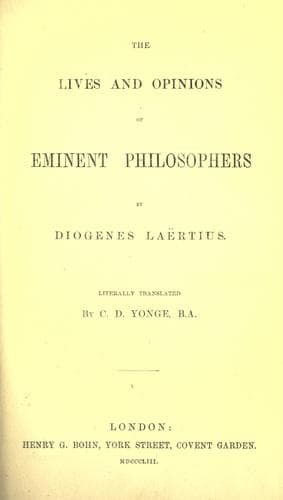
The Lives and Opinions of Eminent PhilosophersDiogenes Laertius
Philosophy
The Lives and Opinions of Eminent Philosophers
Diogenes Laertius
Philosophers, Ancient -- Biography; Philosophy, Ancient
Again, of arguments, some are true, and some are false. Those are true
which deduce a conclusion from true premisses, as, for instance, “If
virtue profits, then vice injures.” And those are false which have
some falsehood in their premisses, or which are inconclusive; as, for
instance, “If it is day, it is light; but it is day, therefore, Dion is
alive.”
There are also arguments which are possible, and others which are
impossible; some likewise which are necessary, and others which are not
necessary. There are too, some which are not demonstrated from their not
standing in need of demonstration, and these are laid down differently
by different people; but Chrysippus enumerates five kinds, which serve
as the foundation for every kind of argument; and which are assumed in
conclusive arguments properly so called, and in syllogisms, and in modes.
The first kind that is not demonstrated, is that in which the whole
argument consists of a conjunctive and an antecedent; and in which
the first term repeats itself so as to form a sort of conjunctive
proposition, and to bring forward as the conclusion the last term. As,
for instance, “If the first be true, so is the second; but the first
is true, therefore, so is the second.” The second kind that is not
demonstrated, is that which, by means of the conjunctive and the opposite
of the conclusion, has a conclusion opposite to the first premiss. As,
for instance, “If it be day, it is light; but it is night, therefore it
is not day.” For here the assumption arises from the opposite of the
conclusion, and the conclusion from the opposite of the first term.
The third kind that is not demonstrative, is that which, by a negative
combination, and by one of the terms in the proposition, produces the
contradictory of the remainder; as, for instance, “Plato is not dead and
alive at the same time but Plato is dead; therefore, Plato is not alive.”
The fourth kind that is not demonstrative, is that which, by means of a
disjunctive, and one of those terms which are in the disjunctive, has
a conclusion opposite to what remains; as, for instance, “It is either
the first, or the second; but it is the first; therefore, it is not the
second.” The fifth kind that is not demonstrative, is that in which the
whole argument consists of a disjunctive proposition, and the opposite of
one of the terms, and then one makes the conclusion identical with the
remainder; as, for instance, “It is either day or night; but it is not
night; therefore it is day.”
According to the Stoics, truth follows upon truth, as “It is light,”
follows upon “It is day.” And falsehood follows upon falsehood; as,
“If it is false that it is night, it is also false that it is dark.”
Sometimes too, truth follows from falsehood; for instance, though it is
false that “the earth flies,” it is true that “there is the earth.” But
falsehood does never follow from truth; for, from the fact that “there is
the earth,” it does not follow “that the earth flies.”
Public-domain text, read in full here on John Shaqi.
Reviews
Reviews
No reviews yet
Be the first to share your thoughts on this work.
Elsewhere in the archive
Join the Discussion
Join the discussion
Sign in to leave a comment or review.
Sign InorCreate an account