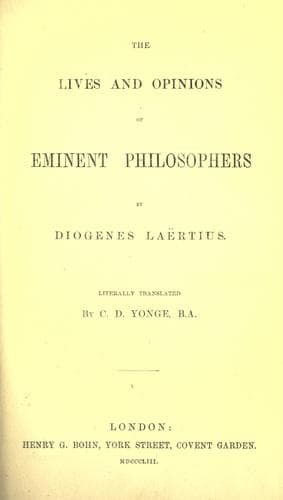
The Lives and Opinions of Eminent PhilosophersDiogenes Laertius
Philosophy
The Lives and Opinions of Eminent Philosophers
Diogenes Laertius
Philosophers, Ancient -- Biography; Philosophy, Ancient
There are also some arguments which are perplexed, being veiled and
escaping notice; or such as are called sorites, the horned one, or the
nobody. That is a veiled argument[88] which resembles the following one;
“two are not a few, nor three, nor those, nor four, and so on to ten; but
two are few; therefore, so are ten few.”
The nobody is a conjunctive argument, and one that consists of the
indefinite and the definite, and which has a minor premiss and a
conclusion; as, for instance, “If any one is here, he is not in Rhodes.”
L. Such then are the doctrines which the Stoics maintain on the subject
of logic, in order as far as possible to establish their point that the
logician is the only wise man. For they assert that all affairs are
looked at by means of that speculation which proceeds by argument,
including under this assertion both those that belong to natural and also
those which belong to moral philosophy: for, say they, how else could one
determine the exact value of nouns, or how else could one explain what
laws are imposed upon such and such actions? Moreover, as there are two
habits both incidental to virtue, the one considers what each existing
thing is, and the other inquires what it is called. These then are the
notions of the Stoics on the subject of logic.
LI. The ethical part of philosophy they divide into the topic of
inclination, the topic of good and bad, the topic of the passions, the
topic of virtue, the topic of the chief good, and of primary estimation,
and of actions; the topic of what things are becoming, and of exhortation
and dissuasion. And this division is the one laid down by Chrysippus,
and Archedemus, and Zeno, of Tarsus, and Apollodorus, and Diogenes, and
Antipater, and Posidonius. For Zeno, of Cittium, and Cleanthes, have, as
being more ancient they were likely to, adopted a more simple method of
treating these subjects. But these men divided logical and the natural
philosophy.
Public-domain text, read in full here on John Shaqi.
Reviews
Reviews
No reviews yet
Be the first to share your thoughts on this work.
Elsewhere in the archive
Join the Discussion
Join the discussion
Sign in to leave a comment or review.
Sign InorCreate an account