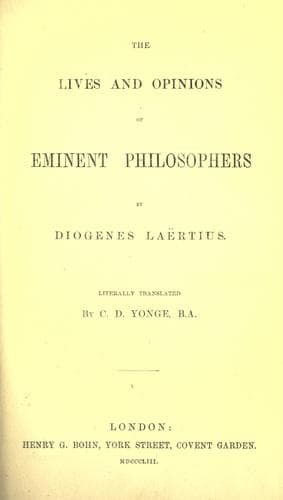
The Lives and Opinions of Eminent PhilosophersDiogenes Laertius
Philosophy
The Lives and Opinions of Eminent Philosophers
Diogenes Laertius
Philosophers, Ancient -- Biography; Philosophy, Ancient
LXV. And they say that virtues reciprocally follow one another, and that
he who has one has all; for that the precepts of them all are common,
as Chrysippus affirms in the first book of his treatise on Laws; and
Apollodorus, in his Natural Philosophy, according to the ancient system;
and Hecaton, in the third book of his treatise on Virtues. For they
say that the man who is endued with virtue, is able to consider and
also to do what must be done. But what must be done must be chosen, and
encountered, and distributed, and awaited; so that if the man does some
things by deliberate choice, and some in a spirit of endurance, and some
distributively, and some patiently; he is prudent, and courageous, and
just, and temperate. And each of the virtues has a particular subject
of its own, about which it is conversant; as, for instance, courage is
conversant about the things which must be endured: prudence is conversant
about what must be done and what must not, and what is of a neutral
or indifferent character. And in like manner, the other virtues are
conversant about their own peculiar subjects; and wisdom in counsel and
shrewdness follow prudence; and good order and decorum follow temperance;
and equality and goodness of judgment follow justice; and constancy and
energy follow courage.
Another doctrine of the Stoics is, that there is nothing intermediate
between virtue and vice; while the Peripatetics assert that there is a
stage between virtue and vice, being an improvement on vice which has not
yet arrived at virtue. For the Stoics say, that as a stick must be either
straight or crooked, so a man must be either just or unjust, and cannot
be more just than just, or more unjust than unjust; and that the same
rule applies to all cases. Moreover, Chrysippus is of opinion that virtue
can be lost, but Cleanthes affirms that it cannot; the one saying that it
can be lost by drunkenness or melancholy, the other maintaining that it
cannot be lost on account of the firm perceptions which it implants in
men. They also pronounce it a proper object of choice; accordingly, we
are ashamed of actions which we do improperly, while we are aware that
what is honourable is the only good. Again, they affirm that it is of
itself sufficient for happiness, as Zeno says, and he is followed in this
assertion by Chrysippus in the first book of his treatise on Virtues, and
by Hecaton in the second book of his treatise on Goods.
Public-domain text, read in full here on John Shaqi.
Reviews
Reviews
No reviews yet
Be the first to share your thoughts on this work.
Elsewhere in the archive
Join the Discussion
Join the discussion
Sign in to leave a comment or review.
Sign InorCreate an account