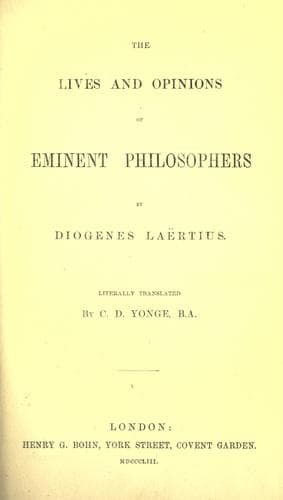
The Lives and Opinions of Eminent PhilosophersDiogenes Laertius
Philosophy
The Lives and Opinions of Eminent Philosophers
Diogenes Laertius
Philosophers, Ancient -- Biography; Philosophy, Ancient
“For if,” says he, “magnanimity be sufficient of itself to enable us to
act in a manner superior to all other men; and if that is a part of
virtue, then virtue is of itself sufficient for happiness, despising all
things which seem troublesome to it.” However, Panætius and Posidonius
do not admit that virtue has this sufficiency of itself, but say that
there is also need of good health, and competency, and strength. And
their opinion is that a man exercises virtue in everything, as Cleanthes
asserts, for it cannot be lost; and the virtuous man on every occasion
exercises his soul, which is in a state of perfection.
LXVI. Again, they say that justice exists by nature, and not because
of any definition or principle; just as law does, or right reason, as
Chrysippus tells us in his treatise on the Beautiful; and they think
that one ought not to abandon philosophy on account of the different
opinions prevailing among philosophers, since on this principle one would
wholly quit life, as Posidonius argues in his Exhortatory Essays. Another
doctrine of Chrysippus is, that general learning is very useful.
And the School in general maintain that there are no obligations of
justice binding on us with reference to other animals, on account of
their dissimilarity to us, as Chrysippus asserts in the first book of his
treatise on Justice, and the same opinion is maintained by Posidonius
in the first book of his treatise on Duty. They say too, that the wise
man will love those young men, who by their outward appearance, show a
natural aptitude for virtue; and this opinion is advanced by Zeno, in
his Republic, and by Chrysippus in the first book of his work on Lives,
and by Apollodorus in his Ethics. And they describe love as an endeavour
to benefit a friend on account of his visible beauty; and that it is an
attribute not of acquaintanceship, but of friendship. Accordingly, that
Thrasonides, although he had his mistress in his power, abstained from
her, because he was hated by her. Love, therefore, according to them is a
part of friendship, as Chrysippus asserts in his essay on Love; and it is
not blameable. Moreover, beauty is the flower of virtue.
Public-domain text, read in full here on John Shaqi.
Reviews
Reviews
No reviews yet
Be the first to share your thoughts on this work.
Elsewhere in the archive
Join the Discussion
Join the discussion
Sign in to leave a comment or review.
Sign InorCreate an account