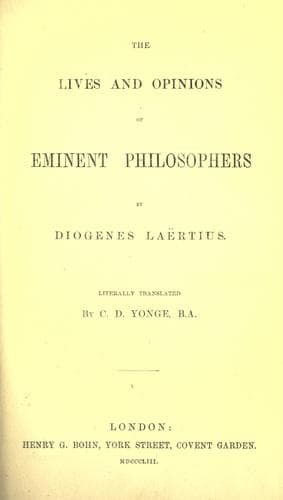
The Lives and Opinions of Eminent PhilosophersDiogenes Laertius
Philosophy
The Lives and Opinions of Eminent Philosophers
Diogenes Laertius
Philosophers, Ancient -- Biography; Philosophy, Ancient
_A._ Think you not then
The case is just the same about the good.
That the good is something by itself, intrinsic
And he who’s learnt, does at once become
Himself a good man? just as he who’s learnt
Flute-playing is a flute-player; or dancing,
A dancer; weaving, a weaver. And in short,
Whoever learns an art, does not become
The art itself, but just an artist in it.
Plato, in his theory of Ideas, says, “That since there is such a thing
as memory, the ideas are in existent things, because memory is only
conversant about what is stable and enduring; and that no other thing
is durable except ideas, for in what way,” he continues, “could animals
be preserved, if they had no ideas to guide them, and if, in addition
to them, they had not an intellect given to them by nature?” But as it
is they recollect similitudes, and also their food, so as to know what
kind of food is fit for them; which they learn because the notion of
similarity is implanted naturally in every animal; owing to which notion
they recognize those of the same species as themselves. What is it then
that Epicharmus says?
Eumæus’ wisdom?—not a scanty gift
Appropriated to one single being;
But every animal that breathes and lives,
Has mind and intellect.—So if you will
Survey the facts attentively, you’ll find,
E’en in the common poultry yard, the hen
Brings not her offspring forth at first alive,
But sits upon her eggs, and by her warmth,
Cherishes them into life. And all this wisdom
She does derive from nature’s gift alone,
For nature is her only guide and teacher.
And in a subsequent passage he says:—
There is no wonder in my teaching this,
That citizens please citizens, and seem
To one another to be beautiful:
And so one dog seems to another dog
The fairest object in the world; and so
One ox seems to another, ass to ass,
And swine to swine.
And these and similar speculations are examined and compared by Alcimus
through four books, where he shows how much assistance Plato has derived
from Epicharmus. And that Epicharmus himself was not indisposed to
appreciate his own wisdom, one may learn from these lines, in which he
predicts that there will arise some one to imitate him:—
But as I think, I surely foresee this,
That these my words will be preserved hereafter
In many people’s recollection. And
Another man will come, who’ll strip my reasons
Of their poetic dress, and, clothing them
In other garments and with purple broidery
Will show them off; and being invincible,
Will make all rivals bow the knee to him.
XIII. Plato also appears to have brought the books of Sophron, the
farce-writer,[31] to Athens, which were previously neglected; and to have
availed himself of them in his Speculations on Morals: and a copy of them
was found under his head.
Public-domain text, read in full here on John Shaqi.
Reviews
Reviews
No reviews yet
Be the first to share your thoughts on this work.
Elsewhere in the archive
Join the Discussion
Join the discussion
Sign in to leave a comment or review.
Sign InorCreate an account