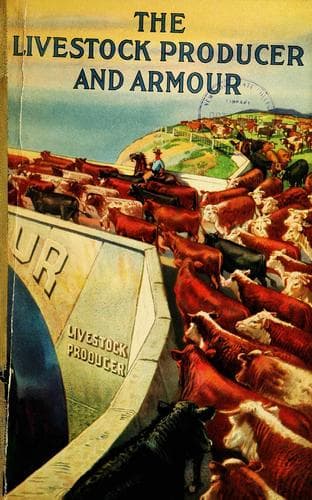
Animal industry -- United States; Packing-house products
Could the commission man sell and the packer buy the livestock if it
were not for another salesman and another buyer out at the farthest end
of the market system transacting business with each other in the retail
market?
Again the question answers itself. For the packer’s salesman is
literally the salesman of the livestock producer at the final market,
upon which all other markets depend. The advertising and educational
activities conducted by the packer continuously broaden and intensify
the ultimate market for the products which the livestock man produces.
It devolves upon these agencies to keep the meat products moving
towards final consumption, just as the man at the measuring spout of
the old-fashioned threshing machine had to keep the grain out of the
way and prevent congestion.
There are two distinct divisions of the process of turning livestock
into available meat supplies. First, the production, shipment and sale
of livestock. Second, the preparation, transportation and distribution
of meat products to retailers. The two are interrelated and absolutely
dependent one upon the other.
The opportunity for organized producers to take complete possession
of their end of the process by assuming control of the stockyards, is
offered in the passing of that control from the packing industries by
virtue of the recent understanding with the U. S. Government.
[Illustration: The packer’s salesman is literally the farmer’s salesman
in the thousands of “final markets” throughout the land.]
Farming as a Business
ALL business undertakings are ventures. Under the best of conditions
there are fat and lean years, and the possibility of failure, due to
poor management, lack of capital, or adversity, is always present.
Farming is no exception. It is in essence a business proposition, and
should be so regarded.
A knowledge of crops, of soils and tillage, of livestock breeding
and feeding and other purely agricultural subjects constitutes but
one side of the farming industry. On top of this come the important
matters of business management—the buying of seeds, fertilizers, feed
stuffs, livestock and general equipment and supplies; the erecting
and maintenance of buildings; the arrangements for necessary credit;
keeping in touch with market conditions and prices; the hiring of
help, and finally the establishing and operation of an accurate
cost-accounting system.
Public-domain text, read in full here on John Shaqi.
Reviews
Reviews
No reviews yet
Be the first to share your thoughts on this work.
Join the Discussion
Join the discussion
Sign in to leave a comment or review.
Sign InorCreate an account