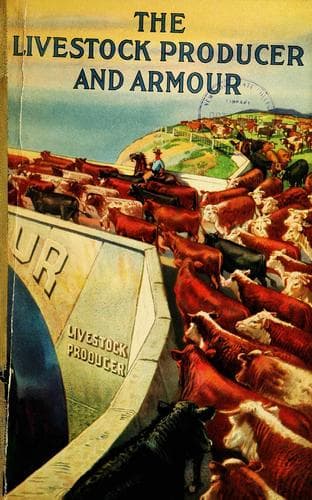
Animal industry -- United States; Packing-house products
Yet when all is said and done, records indicate that farming offers
more chances of success than almost any other line of business
endeavor. A retail merchant, according to statistics, has from two
to four chances in ten to conduct his business successfully for
fifteen years; a manufacturer has from two to seven chances to do the
same. Farming is conspicuous for its small percentage of out-and-out
failures. Living is practically assured, which gives the farmer a
distinct working advantage to begin with. He enjoys a cash market and
is not called upon to suffer bad debt losses. He is in an industry that
is absolutely essential, which cannot be destroyed by any shifting of
circumstances.
The greatest need is doubtless for cost-accounting systems which will
serve as a guide, not only to prevent unwise purchases, but to indicate
wise expenditures in improvements that will bring a good return on
investment, and to show definitely the amount of profit obtained on
each transaction. Next to this in importance is perhaps the need
for a thorough understanding of crop rotation and the principle of
diversified farming as a means of offsetting losses in one line with
gains in another. The securing of credit to enable expansion, and the
adoption of labor-saving devices are also essential.
Profits and losses in farming must be reckoned, as in all other
businesses, on averages over a term of years. But the future
offers better assurance than ever before to the man who is a good
agriculturist and at the same time a skillful business manager.
We Stand or Fall Together
WITH some elements of the American public there seems to persist the
conviction that the great packing concerns are seeking the injury of
livestock producers to their own enrichment. How such an idea can be
seriously harbored by thinking men is hard to understand. For the
packing industry to plan for the farmer anything but prosperity is to
endanger or destroy the source of supply of the raw material by which
it lives and grows.
It should be perfectly plain that the packers are selfishly interested
in encouraging the producer. Their selling efforts are directed towards
disposing of the largest possible volume of meat products, at the best
price obtainable in competition with other foods, in order that they
may maintain large volume of livestock purchases at prices that will
encourage both quantity and quality of production.
Between the producer and the consumer, between the buying and the
selling price, the packers operate upon a smaller margin of profit than
any other large industry. On invested capital they have realized an
average of about 9 per cent over a term of years, on volume of sales
about 2 per cent, and on each pound of meat less than one-half of a
cent.
At the same time the risks of the business are greater than in other
lines, both on account of the perishable nature of the product and the
violent fluctuations of food prices, the causes for which cannot always
be foreseen.
Public-domain text, read in full here on John Shaqi.
Reviews
Reviews
No reviews yet
Be the first to share your thoughts on this work.
Join the Discussion
Join the discussion
Sign in to leave a comment or review.
Sign InorCreate an account