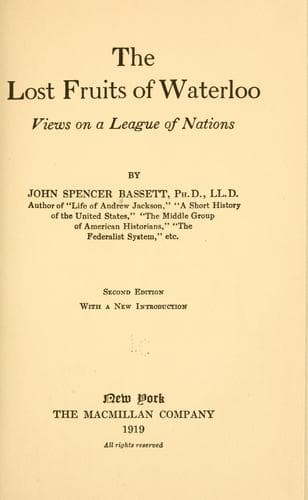
International cooperation; Peace; World War, 1914-1918
Kant’s suggestion was closely kin to Rousseau’s ideas of the state,
but he wrote at a time when the world, stampeded by the excesses
of the Jacobins, was turning away from all the political theories
that underlay the French Revolution. It had no use for the idea that
government was the outcome of a social contract; and if this idea was
not accepted for the state itself, how much less would it be accepted
as a means of organizing the international state! The world suffered
too much at the hands of Napoleon to like ideas that were responsible
for the very beginning of the letting out of the waters. And this was
especially true in Prussia, where the foot of the French conqueror was
extremely heavy.
At the moment when Kant’s ideas were at the height of unpopularity
came the young philosopher, Hegel, who announced a philosophical
view of war that pleased the governing class of Prussia, bent on
establishing a system of military training that would be sufficient
for a redeemed country. He taught that war through action burns away
moral excrescences, purifies the health of society, and stimulates
the growth of manly virtue. This idea became the basis of much German
reasoning, and it is not improbable that its defenders in trying to
discern the virtues they argued for, were led to develop them. But in
their enthusiasm they came to exaggerate these virtues into habits that
were often mere manifestations of an exalted egoism. As to the claim
that war burns up the effete products of society, it may be met by the
undeniable assertion that it also burns much that is best. One does not
burn a city to destroy the vermin that are in it.
The next attempt to bring about a system of coöperation to secure
peace among the nations was the formation of the Holy Alliance, a
futile attempt to apply principles like those just described, made by
Alexander I, of Russia, at the close of the Napoleonic wars. It is
considered at length in the chapter following this, where it finds
its proper setting. The extremely religious spirit in which it was
conceived was a drawback to success, but it is not likely that it
would have fared better than it did fare, even if stripped of all its
pious fantasy, since the world was not educated to its acceptance as a
purely political idea.
At this stage one must notice the development of peace societies.
Organized at first as local bodies they were drawn together into
national organizations in the early decades of the nineteenth century.
It was in 1816 that such a society was created in Great Britain, and in
1828 that the American Peace Society was formed out of local societies
in the United States. In the same year was established at Geneva the
first peace society on the Continent, the second being organized at
Paris in 1841. The influence of such societies was weak for a long
time; but within the past twenty years it has been much stronger.
Public-domain text, read in full here on John Shaqi.
Reviews
Reviews
No reviews yet
Be the first to share your thoughts on this work.
Join the Discussion
Join the discussion
Sign in to leave a comment or review.
Sign InorCreate an account