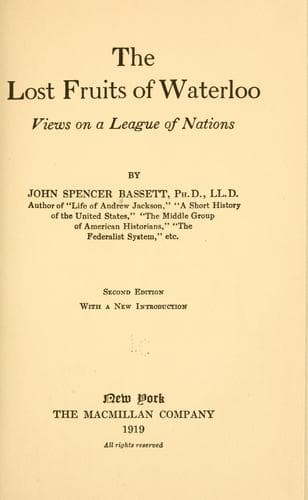
International cooperation; Peace; World War, 1914-1918
One of the most striking examples of the prevalence of the peace
idea in recent times is the growing use of arbitration as a means
of settling international disputes. Another is the meeting of the
Hague conferences to promote peace. The first was called by the tsar,
Nicholas II, in 1899 and laid a broad outline of the work that
such conferences ought to do. A second assembled in the year 1907,
and a third was about to convene when the Great War began in 1914.
The conferences devoted their strongest efforts to the reduction of
armaments and the checking of militarism; but in each case they found
the German Empire planted boldly across their path, and in this respect
their efforts were futile. It is not to be doubted that the attitude of
Germany contributed much to develop the widespread suspicion of that
country which has been one of her handicaps in the present war.
The “peace movement,” as the totality of these activities is called,
has thus gained strength, and it would seem that it must eventually
prevail in public opinion. It received an important momentum in
1910, when Mr. Andrew Carnegie gave $10,000,000 to establish the
Carnegie Endowment for International Peace, an organization which has
contributed powerfully to the promotion of peace ideas. It acts on
scientific principles, seeking to gather and publish such facts bearing
on international relations, the laws of economics and history, and the
science of international law, as will show in what respect war is to be
removed from its hold on society.
The careless enthusiasm with which a great many people hailed the
outbreak of war in 1914 swept the peace advocates into the background
and was the occasion of some sarcasm at their expense. But as the
struggle grew in grimness and horrors the advocates of peace on
principle returned to their old position in public esteem, and have
steadily gained on it. It seems undeniable that the war has done more
to convince the world of the madness of war than many decades of
agitation could do.
Public-domain text, read in full here on John Shaqi.
Reviews
Reviews
No reviews yet
Be the first to share your thoughts on this work.
Join the Discussion
Join the discussion
Sign in to leave a comment or review.
Sign InorCreate an account