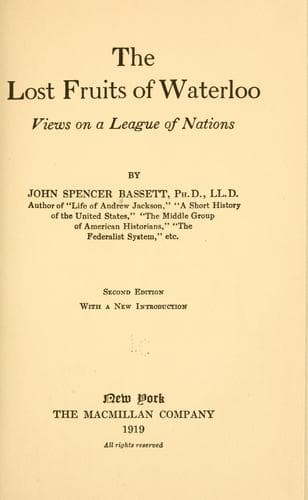
International cooperation; Peace; World War, 1914-1918
From the beginning of the struggle he was to his opponents the
incarnation of all that was hateful in government. Few of the epithets
now hurled at the kaiser were not as lavishly cast at Napoleon. He was
tyrant, robber, brute, and murderer in turn, and it was pronounced a
service to humanity to suppress him. In the beginning of the wars his
pretensions were treated with disdain, but as his victories followed
one another in bewildering rapidity, his power was treated with more
respect, although there was no greater disposition to contemplate
his triumph with complacency. As the struggle became fiercer, the
other states than France began to think of some permanent form of
coöperation for restraining him; and they even began to speculate on
the possibility of some permanent arrangement by which the world might
be saved from a recurrence of such a vast waste of life and treasure as
was involved in the struggle. It was thus that suggestions were made
during the Napoleonic era for abolishing war through international
effort. For us, who are today burdened with the ruin of a similar
but more stupendous struggle, these efforts have a special interest,
and the space of a single chapter is none too much to give to their
consideration.
It is singular that these plans should have found their most
conspicuous supporters in the heads of the two governments most widely
apart with reference to the popular character of their institutions.
It was in autocratic Russia that one found the most advanced idea of
dealing with the future, and in Great Britain, the most liberal of
the great powers, that the most conservative design was held. Each
plan was supported by the head of these two governments respectively,
each ran through its own development while the armies were locked in
deadly struggle, and each was debated with seriousness in the moment of
victory when the statesmen of the winning powers met to arrange for the
future relations of the states whose victories made them the arbiters
of Europe.
The initiative was taken by Alexander I, of Russia. He was a man
of the best intentions, and throughout the period with which we
are now dealing he showed himself persistently favorable to views
which, to say the least, were a hundred years ahead of his time. By
temperament he was imaginative and sympathetic. In his personal life
were irregularities, but not as many as in Napoleon’s, Louis XIV’s,
or Talleyrand’s. He lacked the royal vice of despotism, and his
escape from it was probably due to the influence of Fréderic César
de La Harpe, an instructor of his youth, who arrived in Russia with
his head full of the dynamic ideas of the French philosophers of the
pre-revolutionary period.
Public-domain text, read in full here on John Shaqi.
Reviews
Reviews
No reviews yet
Be the first to share your thoughts on this work.
Join the Discussion
Join the discussion
Sign in to leave a comment or review.
Sign InorCreate an account