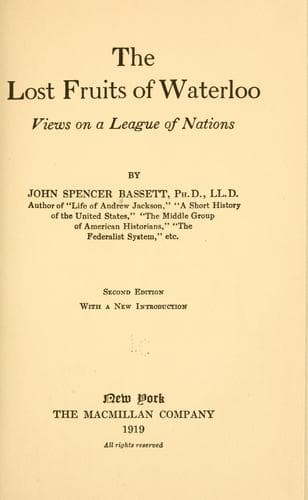
International cooperation; Peace; World War, 1914-1918
To kill a principle demands a principle equally strong and inclusive.
No one nation can keep down war and subjugation; for it must be so
strong to carry out that purpose that it becomes itself a conqueror.
It would be as intolerable to Germany, for example, to be ruled
by the United States as it would be to the United States if they
were ruled by Germany. The only restraint that will satisfy all the
nations will be exercised by some organ of power in which all have
fair representation and in which no nation is able to do things which
stimulate jealousy and give grounds for the belief that some are being
exploited by others. This suggestion does not demand a well integrated
federal government for all the functions of the state but merely the
adoption of a system of coöperation with authority over the outbreak
of international war and strong enough to make its will obeyed. It is
federation for only one purpose and such a purpose as will never be
brought into vital action as long as the federated will is maintained
at such a point of strength and exercised with such a degree of
fairness that individual states will not question that will.
This principle of federated action for a specific purpose was adopted
by the United States in 1789, and though hailed by the practical
statesmen of Europe as an experiment, it has proved the happiest form
of government that has yet been established over a vast territory in
which are divergent economic and social interests. In it is much more
integration than would exist in a federated system to prevent war,
where the action of the central authority would be limited to one main
object. If it could be formed and put into operation by the present
generation, who know so well what it costs to beat back the spectre of
world conquest it might pass through the preliminary critical stages
of its existence successfully. At any rate, the world is full of the
feeling that such things may be possible, and it would be unwise to
dismiss the suggestion without giving it fair and full consideration.
The discussion brings up what seems to be a law of human activities,
that as the ages run and as men develop their minds they combine in
larger and larger units for carrying on the particular thing they are
interested in. And they make these combinations by force or through
mutual agreement. We have before us the consideration of the most
important form of this unifying process, the unification of nations,
which has generally come through force, but sometimes has come through
agreement.
Public-domain text, read in full here on John Shaqi.
Reviews
Reviews
No reviews yet
Be the first to share your thoughts on this work.
Join the Discussion
Join the discussion
Sign in to leave a comment or review.
Sign InorCreate an account