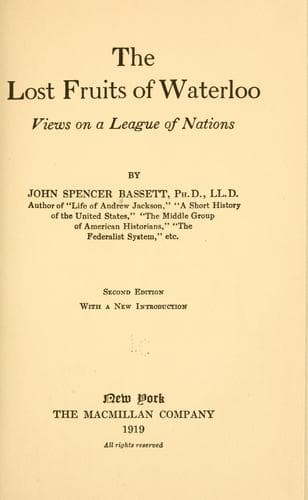
International cooperation; Peace; World War, 1914-1918
In recent industrial history is a parallel process so well illustrating
the point at issue that I can not refrain from mentioning it. In his
book, _My Four Years in Germany_, Mr. James W. Gerard contrasts great
industrial combinations in the United States and Germany. In one
country are trusts, in the other great companies known as cartels.
The development of the trust we know well. It came out of a process
of competitive war. Some large manufacturer who possessed ability for
war, formed an initial group of manufacturers with the prospect of
controlling a large part of the market. He was careful to see that
his own group had the best possible organization, central control,
and a loyal body of subordinates. Then he opened his attack on his
smaller rivals, and in most cases they were driven into surrender or
bankruptcy. It was a hard process, but it led to industrial unity with
its many advantages.
The cartel began with co-operation. All the persons or companies
manufacturing a given article were asked to unite in its creation. They
pooled their resources, adopted common buying and selling agencies,
and shared the returns amicably. They proved very profitable for the
shareholders, and they strengthened the national industry in its
competition against foreigners. In the United States the trust has been
unpopular, despite its many economic advantages. The reason is the
battle-like methods by which it destroyed its rivals. The result was
the enactment of laws to restrain its development, laws so contrary
to the trend of the times that they have been very tardily enforced.
The cartel, established with the co-operation of the whole group of
manufacturers, aroused no antagonism and obtained the approval of the
laws. It is not necessary to say which is the better of these two
methods of arriving at the same object.
Public-domain text, read in full here on John Shaqi.
Reviews
Reviews
No reviews yet
Be the first to share your thoughts on this work.
Join the Discussion
Join the discussion
Sign in to leave a comment or review.
Sign InorCreate an account