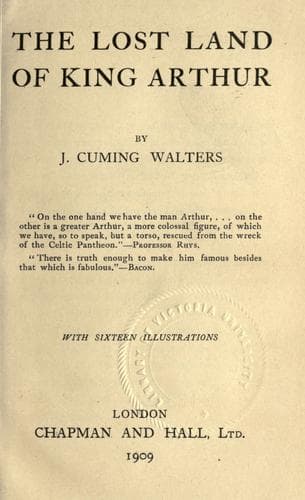
Arthur, King -- Homes and haunts -- England -- Cornwall (County); Cornwall (England : County) -- Antiquities, Celtic
Nennius is supposed to have compiled another comprehensive history
comparable with that of Gildas--_Historia Britonum_--the period
embraced being from the days of Brute the Trojan to the year 680 A.D.
But so much doubt prevails as to his work, that the history, despite
the later date, has been ascribed to Gildas himself. Both may have been
forgeries of the tenth or eleventh century. For five or six centuries
the story of Arthur was “folk-lore,” and was preserved in snatches
of song, a few fragments of which still exist. Such a legend, as
Longfellow says, can only--
“Spring at first
Out of the hunger and the thirst
In all men for the marvellous.
And thus it filled and satisfied
The imagination of mankind,
And this ideal to the mind
Was truer than historic fact.”
Songs in praise of heroes, real or mythical, always exist among rude
peoples--the sagas which nations unwillingly let die. They are the
repository of national history, the inspiration of an aspiring and
progressive race, the embodiment of its hopes, the treasury of its
traditions. Mythology, “the dark shadow which language throws on
thought,” is the first outcome of mental activity and percipience--the
struggle for human expression of all that is marvellous and memorable.
All the early history of races is mixed and engloomed with dim
allegories. Intense reverence for divinities, or the awe of them, leads
to the making of fables and the reciting of marvels, in which the gods
speak and act as men, or men speak and act as gods. The thoughts of
primitive peoples are concentrated upon the hero, the commanding figure
who typifies their desires, and about whose name cluster legends of
victory. Not infrequently, divine qualities are attributed to that
hero who thus looms majestically upon the horizon of history, and
ultimately becomes a religion. “The gods of fable are the shining
moments of great men,” Emerson said, and whether the Arthurs and Odins
of mythology were men worshipped as deities, or deities divested of
divinity and transformed into historic heroes, the after-ages must
always have some difficulty in deciding. What we know is that the
interval between language and literature is crowded with shadowy
mythological lore, and little of the light flashed back from to-day can
illumine the haunted, mystic, twilight time of phantom and superstition.
Public-domain text, read in full here on John Shaqi.
Reviews
Reviews
No reviews yet
Be the first to share your thoughts on this work.
Join the Discussion
Join the discussion
Sign in to leave a comment or review.
Sign InorCreate an account