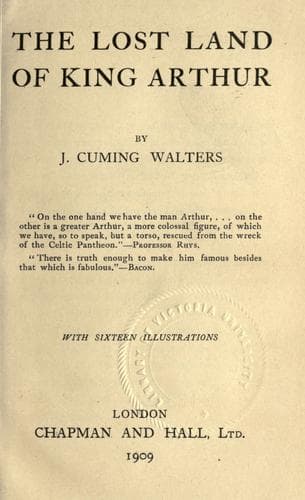
Arthur, King -- Homes and haunts -- England -- Cornwall (County); Cornwall (England : County) -- Antiquities, Celtic
Yet Geoffrey, Archdeacon of Monmouth, and afterwards Bishop of St.
Asaph (1100-1154), in giving shape and substance to the Arthurian
legends and traditions, had no better material to work with than that
supplied by the British folk-songs, the tainted records of Gildas and
Nennius, and the so-called Armoric collections of Walter, Archdeacon
of Oxford, who flourished in the eleventh century, and connected the
Arthur of Brittany with the Arthur of Siluria. Geoffrey’s famous
_Chronicon sive Historia Britonum_, dedicated to Robert, Earl of
Gloucester, and given to the world in the Latin tongue in the year
1115, was professedly a translation of the _Brut y Brenhined_, a
“history of the Kings of Britain, found in Brittany,” best described in
Wordsworth’s phrase: “A British record long concealed in old Armorica,
whose secret springs no Gothic conqueror e’er drank.”
In reality his imagination had been fired by the bardic celebrations of
Arthur’s triumphs, the songs still sung vauntingly by an unconquered
race. The old monkish chronicler manifested a marvellous ingenuity in
imparting circumstantiality of the most convincing character to his
narrative. He connected place-names of great repute with eponymous
heroes; he linked the truths of the Roman occupation with the
half-truths or fables of the British resistance; he wove some of the
most striking Scriptural facts into the fabric of the romance; he so
leavened falsehood with reality that the imposture was hard to detect,
especially in an uncritical age, and the effect was most impressive
upon the minds of an unreasoning generation. His inventions did not
extend to incidents; these he took from the chronicles to hand, and he
can only be charged with a free amplification of the records, and a
readjustment of the events which had been described. Notwithstanding
all the craft and devices of the chronicler, however, his history was
almost immediately challenged, William of Newburgh, a Yorkshire monk,
declaring that Geoffrey had “lied saucily and shamelessly,” with many
other hard terms. He charged the supposed chronicler with making use
of, and wholly depending upon, the old Breton tales, and with adding
to these contestable compilations “increase of his own.” Nor was
William of Newburgh alone in his protests and denunciation. Giraldus
Cambriensis, by a parable, implied that Geoffrey’s work was a deceit.
There was a man at Caerleon, he said, who could always tell a liar
because he saw the devil and his imps leaping upon the man’s tongue.
The Gospel of St. John was given him; he placed it in his bosom; and
the evil spirits vanished. Then the _History of the Britons_, by
“Geoffrey Arthur” (“Arthur” was a by-name of Geoffrey’s), was handed
to him, and the imps immediately reappeared in greater numbers, and
remained a longer time than usual on his body and on his book. _Cœdit
quæstio_. But all this did not prevent Geoffrey’s masterpiece in nine
Public-domain text, read in full here on John Shaqi.
Reviews
Reviews
No reviews yet
Be the first to share your thoughts on this work.
Join the Discussion
Join the discussion
Sign in to leave a comment or review.
Sign InorCreate an account