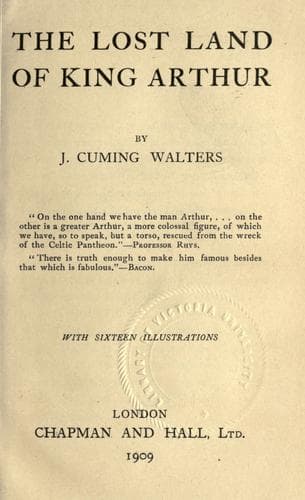
Arthur, King -- Homes and haunts -- England -- Cornwall (County); Cornwall (England : County) -- Antiquities, Celtic
If this were the place for sermons it might be pointed out that the
vitality of the Thorn is an emblem of the vitality of the religion it
commemorates; but our duty is to trace its connection with history.
The legend has been somewhat altered in form in order to bring it into
direct association with the building of the Abbey. This new version
of the miracle is that Joseph of Arimathæa was commanded to build a
church in honour of the Virgin Mary, but finding that the natives
were distrustful of him and his mission he prayed, like Gideon,
for a miracle. Forthwith his staff began to shoot forth leaves and
blossoms, and the unwithered Thorn took root. Be that as it may, the
first Christians built a chapel of twisted alder, in the form of a
parallelogram, 60 feet long and 26 feet broad (to come to details),
and having “a window at the west end and one at the east; on each side
were three windows, and near the western angle was a door each side.”
A representation of the first building for Christian worship erected
in this country is found on an old document now in the British Museum,
and it is said to have been copied from a plate of brass which had been
affixed to an adjoining pillar. The chapel is variously referred to
in ancient records as “Lignea Basilica,” “Vetusta Ecclesia,” and the
“Ealdechirche,” and with its walls of wattles and its roof of rushes it
must long have been an object of revered contemplation. Joseph built
and preached in “the little lonely church,” “built with wattles from
the marsh,” journeying from thence across the plain to the Mendips,
where he found other half barbarous Britons to listen to the story of
the Redemption. He laid the foundations of a bishopric at Wells, which
was afterwards to be the rival of Glastonbury Abbey itself, and to the
end of a long and fruitful life continued his ministry to the people.
Chalice Hill revives by its name and associations another reminiscence
of our Lord even more amazing. St. Joseph was the bringer to this
country of two precious relics--one--
“The Cup itself from which our Lord
Drank at the last sad supper with His own,”
Public-domain text, read in full here on John Shaqi.
Reviews
Reviews
No reviews yet
Be the first to share your thoughts on this work.
Elsewhere in the archive
Join the Discussion
Join the discussion
Sign in to leave a comment or review.
Sign InorCreate an account