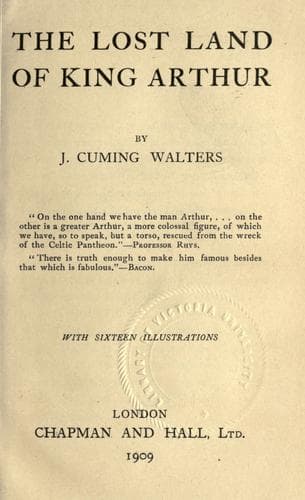
Arthur, King -- Homes and haunts -- England -- Cornwall (County); Cornwall (England : County) -- Antiquities, Celtic
According to Professor Freeman, Glastonbury became, in the year 601,
the great sanctuary of the British in the place of Ambresbury, which
had but lately fallen. How it grew, how it was ruled by great leaders
in the church, how it became the largest, the most beautiful, the most
wealthy of all abbeys, how its fall was compassed, and how the last of
its abbots, an aged man, was dragged to the hill-top and hanged, are
historic facts which belong to a date far later than that with which
we are concerned. We cannot even dwell upon St. Patrick’s sojourn at
Glastonbury, or upon Dunstan’s retirement to its cloisters in order to
devote himself to study and music. Here it was that he wrestled with
the Evil One in person while labouring at his forge; here it was that
heavenly visions were vouchsafed to him; here it was that he began
his work of reformation in the Church and made the Abbey the centre
of religious influence in the kingdom. After the lapse of centuries
we gaze only upon the ruins of the fabric, and from them learn how
majestic the temple in its prime must have been, comprehending a little
of the truth half revealed and half concealed in the silent storied
places with their shattered walls, their crumbling archways, their
unroofed chambers, their windows darkened with trailing weeds, and
their floors overgrown with lank grasses and moss.
King Arthur’s connection with Glastonbury cannot be deemed wholly
mythical, though the mysteriously beautiful narrative which tells of
his last days in Avalon seems too poetical for reality. There are,
however, other links, not so generally recognised, connecting him with
this consecrated place. Glastonbury was not only his “isle of rest;”
nor was the Abbey known only to him as a shrine. He claimed, or it
was claimed for him, that he was descended on his mother’s side from
Joseph of Arimathæa, the genealogy being thus given:--“Helianis, the
nephew of Joseph, begat Joshua; Joshua begat Aminadab; Aminadab begat
Castellos; Castellos begat Mavael; Mavael begat Lambord, who begat
Igerna of whom Uther Pendragon begat the famous and noble Arthur.”
Glastonbury, in addition to its celebrity as a Christian sanctuary,
would therefore have a claim upon King Arthur’s attention for the sake
of his venerated ancestor, though there seems little reason to doubt
that in his day it was the cynosure of the eyes of all who claimed
to be within the religious fold. Lady Charlotte Guest, in one of the
valuable notes to her translation of the _Mabinogion_, calls attention
to a record of William of Malmesbury, which proves how much Glastonbury
was in King Arthur’s mind on all occasions. “It is written in the Acts
of the illustrious King Arthur,” we read, “that at a certain festival
of the Nativity, at Caerleon, that monarch having conferred military
distinction upon a valiant youth of the name of Ider, the son of King
Nuth, in order to prove him, conducted him to the hill of Brentenol,
Public-domain text, read in full here on John Shaqi.
Reviews
Reviews
No reviews yet
Be the first to share your thoughts on this work.
Elsewhere in the archive
Join the Discussion
Join the discussion
Sign in to leave a comment or review.
Sign InorCreate an account