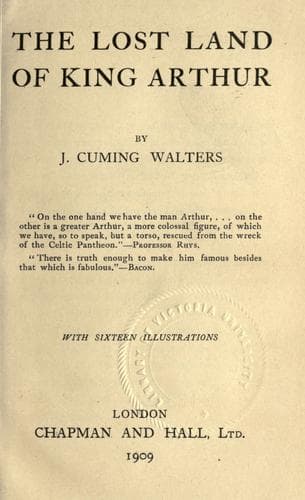
Arthur, King -- Homes and haunts -- England -- Cornwall (County); Cornwall (England : County) -- Antiquities, Celtic
for the purpose of fighting three most atrocious giants. And Ider,
going before the rest of the company, attacked the giants valorously,
and slew them. And when Arthur came up he found him apparently dead,
having fainted with the immense toil he had undergone, whereupon he
reproached himself with having been the cause of his death, through
his tardiness in coming to his aid; and _arriving at Glastonbury_, he
appointed there four-and-twenty monks to say mass for his soul, and
endowed them most amply with lands, and with gold and silver, chalices,
and other ecclesiastical ornaments.” From this we might well infer
that King Arthur was in the habit of paying periodical visits to the
island-valley. “The great Lady Lyle of Avelyon,” girt with a sword
which only Balin could draw from its scabbard, with results afterwards
disastrous to himself, is a link in the associations of Arthur and his
court with the island-valley.
His war with King Melvas, of Somersetshire (strongly reminiscent of
the last war with Mordred, as related by Malory), reads like veritable
history. While engaged in subduing the savage hordes in Wales and
Cornwall, and in beating back the advancing Saxons, he found that
the “Rex Rebellus” Melvas had stolen away his wife Guinevere, and
carried her to Ynyswytryn. King Arthur gathered a large force, and
set out with his knights to take summary vengeance on the ravisher,
whom he forthwith besieged. A well-known antiquary has found reason to
believe that Arthur’s force was “a numberless multitude;” but at all
events there is little doubt that Melvas, who was only an “underlord,”
would have been heavily defeated had a battle ensued. But conflict
was avoided by the intervention of Gildas, the Abbot, who commanded
Melvas to restore Guinevere to her rightful lord, and then succeeded in
reconciling the two foes. They both ended by swearing friendship and
fidelity to the Abbot, and the facts go far to show the potentiality
of that dignitary at this period. Thus, by establishing King Arthur’s
connection with Glastonbury, we increase the likelihood of his choosing
the holy place at Avalon for his last resting-place. He knew the shrine
well and had visited the fruitful, balmy island-valley in which his
ancestor’s name was deeply revered; and when his time drew nigh he
could think of no sweeter, better spot in which to seek for peace.
“Comfort thy selfe,” said the king to weeping Sir Bedivere after the
last battle, “and do as well as thou maiest, for in mee is no trust for
to trust in; for I wil into the vale of Avilion for to heale me of my
grievous wound; and if thou never heere more of me, pray for my soule.”
And with the three mourning queens he passed from the bloody field of
Camlan up the waters of the Bristol Channel to the isle
“Where falls not hail, or rain, or any snow,
Nor ever wind blows loudly.”
Public-domain text, read in full here on John Shaqi.
Reviews
Reviews
No reviews yet
Be the first to share your thoughts on this work.
Elsewhere in the archive
Join the Discussion
Join the discussion
Sign in to leave a comment or review.
Sign InorCreate an account