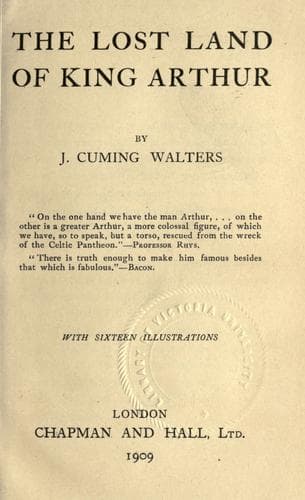
Arthur, King -- Homes and haunts -- England -- Cornwall (County); Cornwall (England : County) -- Antiquities, Celtic
“King Arthur, being wounded in battle, was brought to Glastonbury
to be healed of his wounds by the healing waters of that place,” an
old record runs. But his wound was too grievous; and though Merlin
prophesied that he “cannot die,” the current tradition is that when
he reached the sacred isle he “came unto his end.” In the time of the
first Plantagenet, when the fame of King Arthur was revived, search
was made at Glastonbury for the bones of the great British chief.
Henry II. was then on his way to Ireland, and Henry of Bloys, then
Abbot of Glastonbury, undertook the task, fully intending, no doubt,
that it should be successful. Between two pillars at a depth of nine
feet a stone was found with a leaden cross inscribed on its under side
in Latin, “Here lies buried the renowned King Arthur, in the isle of
Avalon”; and seven feet lower down his body was found in an oaken
coffin. The historian Selden gives us an instructive report of how King
Henry was induced to set about the strange enterprise of discovering
the remains of King Arthur. He tells us that the king in his expedition
towards Ireland was “entertained by the way in Wales with bardish
songs, wherein he heard it affirmed that in Glastonbury (made almost
an isle by the river’s embracements) Arthur was buried betwixt two
pillars. He therefore gave commandment to Henri of Blois, then Abbot,
to make search for the corps, which was found in a wooden coffin
(Girald saith oaken, Leland thinks alder), some sixteen foot deep; but
after they had digged nine foot they found a stone on whose lower side
was fixt a leaden cross (crosses fixt upon the tombs of old Christians
were in all places ordinary) with his name inscribed, and the letter
side of it turned to the stone. He (King Arthur) was then honoured with
a sumptuous monument, and afterwards the sculls of him and his wife
Guinevere were taken out (to remain as separate relics and spectacles)
by Edward Longshanks and Eleanor.” But notwithstanding the useful
and apposite inscription on the leaden cross, “Hic jacet sepultus
inclytus rex Arthurus in insula Avalonia”; or as it is otherwise more
epigrammatically given, “Hic jacet Arthurus, Rex quondam, Rexque
futurus”--
“His Epitaph recordeth so certaine
Here lieth King Arthur that shall raigne againe;”--
Public-domain text, read in full here on John Shaqi.
Reviews
Reviews
No reviews yet
Be the first to share your thoughts on this work.
Elsewhere in the archive
Join the Discussion
Join the discussion
Sign in to leave a comment or review.
Sign InorCreate an account