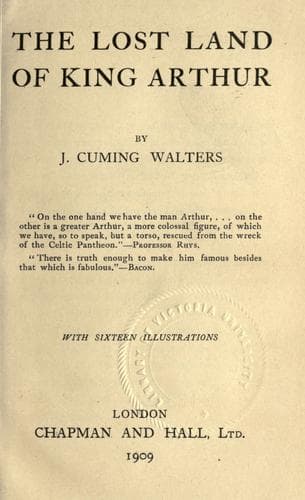
Arthur, King -- Homes and haunts -- England -- Cornwall (County); Cornwall (England : County) -- Antiquities, Celtic
For the love of the king his work was done. His
Latin satirical poems display his chief characteristics, and it is
as a wit rather than a writer that he was famous at the Court. Yet
it was this man who is held to have conceived the character of the
pure and stainless knight Sir Galahad, assigning to him what is in
some respects the chief, or at all events the worthiest, position in
the Arthurian list of knights. If Sir Galahad, stainless, chivalrous,
alone capable of achieving the Quest of the Grail, were the creation of
Walter Map, to him we owe that spiritual and religious element which
refines and enriches King Arthur’s history. Map wrote the story of the
Grail, a Christianised rendering of Celtic myth, and to him probably
we owe the moving and impressive _Mort_, with those notable outbursts
which rank among the treasures of our literature. He, however, had
the originals to work upon. The Welsh had taken their legends to
Brittany, the troubadours were singing them, and the German and the
French chroniclers were at work. And though there is no doubt that
Map contributed in a considerable degree to the romances, it must be
faithfully recorded that questions have arisen whether he was really
capable of doing all that has been attributed to him, and whether, if
he had the capacity, he would also have had the inclination. “Spotless
spirituality,” such as he is supposed to have infused into the story,
is scarcely consistent with the character of the man whose Anacreontics
are often lacking in refinement.[3]
So far, it will be easily conceded, very little has been advanced in
the way of proof of the existence of the British prince and hero, of
the Cymric “Dux Bellorum,” of the Chief of the Siluri or Dumnonii,
the name given to the remnant of the British races driven westward
by the Saxons. We can understand Milton questioning who Arthur was,
and doubting “whether any such reigned in Britain.” “It had been
doubted heretofore, and may be again with good reason,” he wrote,
notwithstanding the fascination possessed by--
“What resounds
In fable or romance of Uther’s son
Begirt with British and Armoric knights.”
Public-domain text, read in full here on John Shaqi.
Reviews
Reviews
No reviews yet
Be the first to share your thoughts on this work.
Join the Discussion
Join the discussion
Sign in to leave a comment or review.
Sign InorCreate an account