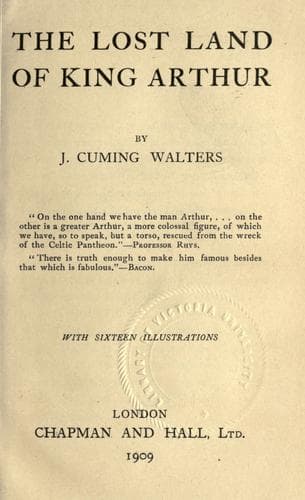
Arthur, King -- Homes and haunts -- England -- Cornwall (County); Cornwall (England : County) -- Antiquities, Celtic
Geoffrey’s “monument of stupendous delusion” had not deceived him, and
Sir Thomas Malory’s laborious compilation, while winning unstinted
admiration for its beauty, richness, and delectation, would be as
unconvincing historically as were Caxton’s quaintly-argued evidences.
All the tributaries which now combined to make the full broad current
of Arthurian literature were infected at their sources, numerous and
widely separated as those sources were. If Malory depended, as we have
the authority of the best scholars for believing, upon the several
ancient romances of Merlin, the inventions and adaptations of Walter
Map, the mysterious compilations of pseudonymous “Helie de Bouri” and
“Luces de Gast,” with other manuscripts--some of which are untraced--of
like character, it was obvious that he was only presenting us with an
aggregation of the impostures, inventions, fables, and falsities of
the centuries preceding. That Malory had a conscientious belief in the
romance is extremely probable, though in the absence of all information
concerning him--for he is a name, a great name, and little more--we can
only infer this from the scrupulous manner in which he has performed
his task and from the commendatory form in which it was issued in the
year 1485.
Judged purely as literature, and with every allowance made for want
of uniformity in level as well as for the tediousness of numberless
digressions, Malory’s romance only admits of one opinion; and to
him and to Caxton (who, despite the humility of his prologues and
epilogues, and his professions of “simpleness and ignorance,” was a
scholar and a master of middle-class English) the race is under a
perpetual debt.[4] The compiler does not seem to be open to the charge
levelled against him by Sir Walter Scott, that he “exhausted at hazard,
and without much art or combination, from the various French prose
folios”; on the contrary it is easy to conceive that he exercised
that “painful industry” with which he is credited by the writer of
the Preface to the edition of 1634. In addition to this, he stamped
his own individuality upon the work, and manifested a singular purity
of taste by removing the grosser elements which stained many of the
earlier versions, and by preserving all that was best as literature and
in keeping with the finest and truest spirit of romance. We know from
the scholarly investigations of Dr. Sommer and Sir Edmund Strachey
how judicious Malory was in translating from his “French books,” or in
making abstracts, or in amending and enlarging. With true insight he
chose the material that was of good report and of genuine worth; the
dross he cast aside. Malory may have belonged to a Yorkshire family,
judging from the fact that Leland recorded that a Malory possessed a
lordship in that county, but there is no slight authority for believing
that he was a Welshman and a priest--“a servant of Jesu both day and
night,” as he himself said. That he was a good and earnest Christian
Public-domain text, read in full here on John Shaqi.
Reviews
Reviews
No reviews yet
Be the first to share your thoughts on this work.
Join the Discussion
Join the discussion
Sign in to leave a comment or review.
Sign InorCreate an account