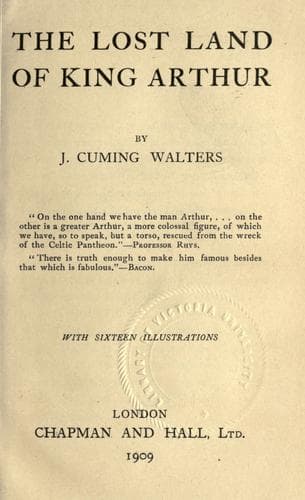
Arthur, King -- Homes and haunts -- England -- Cornwall (County); Cornwall (England : County) -- Antiquities, Celtic
his own work proves beyond all question, for he imparted all the
religious ardour to the romance that he could, and accentuated that
element when it had already been introduced.
The romance of Arthur was enriched, to use Gibbon’s words, with
the various though incoherent ornaments which were familiar to the
experience, the learning, or the fancy of the twelfth century. Every
nation enhanced and adorned the popular romance, until “at length the
light of science and reason was re-kindled, the talisman was broken,
the visionary fabric melted into air, and by a natural though unjust
reverse of public opinion the severity of the present age became
inclined to question the existence of Arthur.” That Arthur’s name
should stream like a cloud, man-shaped, from mountain-peak is the fault
of the mediæval writers who, in taking the British king for their hero,
could represent no age but their own, and had no consciousness of
anachronism. It came natural to them in speaking of the sixth-century
knights to endow them with the attributes of the thirteenth and
fourteenth century, and to describe Arthur’s Britain much as they
would have described the Britain of a Henry or an Edward. The Arthur
of Geoffrey, of Walter Map, and of Malory is as impossible as the
Arthur of Wagner, Lytton, Swinburne, and Tennyson. Most of the writers
on chivalry have either viewed and treated the Knights of the Round
Table as contemporary heroes, or have altogether idealised them. We
are forced to the conclusion that Geoffrey and all the other mediæval
chroniclers had no real conception of the character of the age of
which they wrote; if they discovered real names and real persons they
transported them to an imaginary world and invested them with fabulous
attributes. They made reality itself unreal, transformed heroes into
myths, and buried history beneath romance; they had no power to
recognise truth even when it appeared to them.
Public-domain text, read in full here on John Shaqi.
Reviews
Reviews
No reviews yet
Be the first to share your thoughts on this work.
Join the Discussion
Join the discussion
Sign in to leave a comment or review.
Sign InorCreate an account