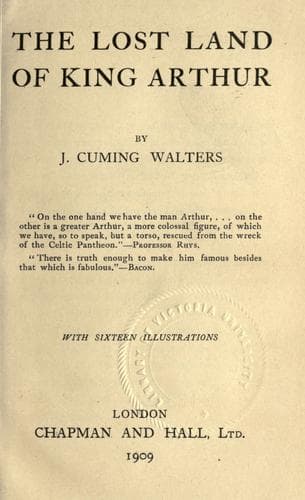
Arthur, King -- Homes and haunts -- England -- Cornwall (County); Cornwall (England : County) -- Antiquities, Celtic
All have felt the influence of Arthur’s history, “its dim enchantments,
its fury of helpless battle, its almost feminine tenderness of
friendship, its fainting passion, its religious ardours, all at length
vanishing in defeat and being found no more.” We have seen how the
Arthurian history, real or fabulous, arose from early traditions and
grew as each chronicler handled it and combined with it the traditions
and the fictions of other races. It lost nothing by its transfusion
into new tongues, but was enriched by the imaginations of the adapters
and combined with the stories already current in other lands. The
hero that Celtic boastfulness had created became the representative
hero of at least three peoples in these early times, and the songs of
the Trouvères speedily spread his fame over Western Europe. We find
Arthur represented as the master of a vast kingdom, and his power
extending to Rome itself; and we find him claimed as the natural hero
of nearly every race which heard his praise and was kindled to valour
by the example of his exploits. Each country seemed bent upon supplying
at least one representative of the Table Round, and eagerly competed
for the pre-eminence and perfection of the knight of its choice. The
kingdom allotted to him was without limit, and as the elder Disraeli
would put it, “fancy bent her iris of many-softened hues over a
delightful land of fiction.”
Lost though King Arthur’s realm is, the land of the ancient British
chieftain must have been real, and it is most possible that we tread
the dust which covers it in journeying from Caerleon to Glastonbury,
from Glastonbury to Camelford, from Camelford to Tintagel. To these
places is our pilgrimage directed.
CHAPTER II
OF LYONNESSE AND CAMELIARD
“In olde dayes of the King Artour,
Of which that Bretons speken gret honour,
All was this lond fulfilled of faerie.”--_Chaucer._
“I betook me among those lofty fables and romances which recount in
solemn cantos the deeds of knighthood founded by our victorious kings,
and from hence had in renown over all Christendom.... Even these books
proved to me so many incitements to the love and steadfast observation
of virtue.”--_Milton._
“Time upon my waste committed hath such theft,
That it of Arthur here scarce memory hath left.”
_Drayton._
No matter how far the chroniclers of old departed from fact in the
details of their narratives, they grouped the incidents around a
central figure, a magnificent ancient hero; and, more than that, they
specified the actual locality in which that hero had won his renown.
But just as they magnified the hero out of all proportion, so they
extended the area of his realm beyond all possibility: hence the
difficulties that meet us in the search for truth.
Public-domain text, read in full here on John Shaqi.
Reviews
Reviews
No reviews yet
Be the first to share your thoughts on this work.
Join the Discussion
Join the discussion
Sign in to leave a comment or review.
Sign InorCreate an account