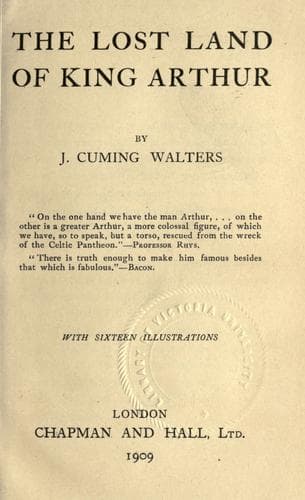
Arthur, King -- Homes and haunts -- England -- Cornwall (County); Cornwall (England : County) -- Antiquities, Celtic
Of the Celts, Ralph Waldo Emerson has perhaps left us, in brief, the
best record. He sums up the greatness and the importance of the race
by saying that of their beginning there is no memory, and that their
end is likely to be still more remote in the future; that they had
endurance and productiveness and culture and a sublime creed; that
they had a hidden and precarious genius; and that they “made the best
popular literature of the Middle Ages in the songs of Merlin and the
tender and delicious anthology of Arthur.” This race was not likely to
take a narrow view of its possessions, or to assign a small territory
to its greatest monarch. Its claim may be preposterous, but that comes
of the consciousness of superior strength and of daring imagination.
Britain was not large enough for the Celts; they required not a country
but a continent. And when their songs were sung, their stories told,
and their great Arthur’s name celebrated throughout the west, they
boldly affirmed that the west was his, and that he had subdued and
ruled the whole civilised world. Arthur’s England became in their eyes
the perfect realm, the ideal place; and the survival of this idea may
be discovered in the works of the poets, old and new.
“Foemen feet to dust have trod
The blue-robed messengers of God,”
was Llywarch Hên’s allusion to the slaughter of bards, evincing his
belief in their sacred character. Song was to the Cymry at once
education, a vent for national feeling, and a memorial of great events.
The bard ranked beside the artisan as one of the pillars of social
life. He had only one theme, his country’s hope, misfortune, and
destiny; and, as M. Thierry has aptly said, the nation, poetical in its
turn, extended the bounds of fiction by ascribing fantastic meaning to
the words. “The wishes of the bards were received as promises, their
expectations as prophecies; even their silence was made expressive. If
they sang not of Arthur’s death, it was a proof that Arthur yet lived;
if the harper undesignedly sounded some melancholy air, the minds of
his hearers spontaneously linked with the vague melody the name of
a spot, rendered mournfully famous by the loss of a battle with the
foreign conqueror. This life of hopes and recollections gave charms,
in the eyes of the latter Cambrians, to their country of rocks and
morasses.” How much we really owe, then, to historic fact and how
much to bardic song the accounting of Camelot and Avalon, Tintagel
and Almesbury, as the famous and redoubtable spots of Arthurian
accomplishments and occupation, would be difficult to decide. Literary
genius from the first centres in the minstrel, who is both composer and
singer, who stimulates to action and records events, who is himself
“doer” and “seer.”
Public-domain text, read in full here on John Shaqi.
Reviews
Reviews
No reviews yet
Be the first to share your thoughts on this work.
Join the Discussion
Join the discussion
Sign in to leave a comment or review.
Sign InorCreate an account