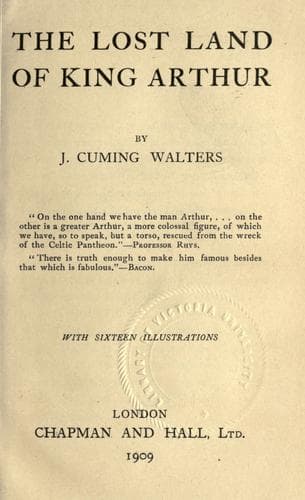
Arthur, King -- Homes and haunts -- England -- Cornwall (County); Cornwall (England : County) -- Antiquities, Celtic
within a small area, we must count all those beyond the Severn and
Trent, unless we adopt the alternative theory and accept the north as
Arthur’s realm. To these we add all the large proportion of places,
more or less fantastically named, which seem to have had no existence
out of the chroniclers’ brain. Where shall we look for Carbonek, for
the land of Petersaint, for Joyous Isle, for Waste Lands, for Lonazep,
for Goothe, for Case, for the Castles of Grail, La Beale Regard,
Pluero, Jagent, and Magouns? to say nothing of a host of others. And
are we to be deluded by the familiarity with which Jerusalem, Tuscany,
Egypt, Turkey, and Hungary are spoken of, into believing that these
distant places were really visited by Arthur and his knights? Even if
we were to concede all the localities mentioned in Malory’s work we
should be confronted by a new difficulty in the _Mabinogion_, where
quite a fresh series of towns and countries is mentioned in addition to
many of the old ones. But while in the _Mabinogion_ the west of Europe
is almost exclusively dealt with, the English, French, and German
historians would be content with nothing less than the best part of the
hemisphere. No petty view, however, must be taken of the Arthur-land of
romance. If Caerleon was his capital, we must believe that he was not
unknown north of the Humber, and that he had a castle in old Carlisle.
Calydon and Brittany, Ireland and Wales, acknowledged his power and
felt his sway. The Roman himself met Arthur face to face; knights
carried his fame to Constantinople--so the early historians asseverate,
and so they doubtless sincerely believed.
Public-domain text, read in full here on John Shaqi.
Reviews
Reviews
No reviews yet
Be the first to share your thoughts on this work.
Join the Discussion
Join the discussion
Sign in to leave a comment or review.
Sign InorCreate an account