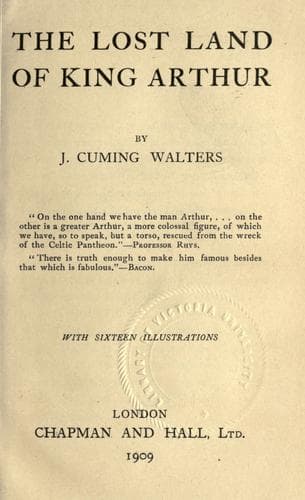
Arthur, King -- Homes and haunts -- England -- Cornwall (County); Cornwall (England : County) -- Antiquities, Celtic
Nor were the repeated efforts of English monarchs to keep alive the
institution conspicuously successful. The original standard could not
be maintained, and the tendency of these later times when the romances
were being enriched and elaborated, when Arthur and his knights were
regarded as models, and when tournaments were held in imitation of the
ancient jousts, was in reality a downward tendency. The ideal which men
strove to realise did not correspond with the spirit of the former age.
“People had become more worldly,” writes Ten Brink, “and were generally
anxious to protect the real interest of life from the unwarrantable
interference of romantic aspirations. The spirit of chivalry no
longer formed a fundamental element, but only an ornament of life--an
ornament, indeed, which was made much of, and was looked upon with a
sentiment partaking of enthusiasm. But now chivalry was no longer the
simple outflow of a dominant idea, but rather the product of a pleasant
self-conscious reflection. Minds ideally constituted strove to fill the
traditional moulds and formulas with a really ethical substance, and by
trying in their own way to transpose these ancient poems into action,
developed a really tender and humane disposition. The majority of
people rejoiced merely in the splendour, and in the festive, dignified
existence that raised them above the commonplace and distinguished them
from the vulgar crowd. But in every case there was the intermixture
of an incongruous element.” The lapse to Quixotism was inevitable,
and with the lashings of the follies of the undiscriminating imitator
of the knights of chivalry, the old custom passed away in derision.
Cervantes did well and did evil by his destructive satire: in cutting
away the parasite, the false and foolish chivalry which had fastened
itself upon the wise and the true, he cut also to the roots of the
goodly tree which deserved to fall more nobly, if fall it must. Renan
reminds us that it was not Arthur the King who has been adopted by all
peoples, but Arthur who charmed the world as the head of an order of
equality in which all sat at the same table, and in which a man’s worth
depended upon his valour and his natural gifts. The fate of an unknown
peninsula mattered nothing to the world--“what enchanted it was the
ideal court presided over by Guinevere, where around the monarchical
unity the flower of heroes was gathered together, where ladies, as
chaste as they were beautiful, loved according to the laws of chivalry,
and where the time was passed in listening to stories, and learning
civility and beautiful manners.”
Public-domain text, read in full here on John Shaqi.
Reviews
Reviews
No reviews yet
Be the first to share your thoughts on this work.
Elsewhere in the archive
Join the Discussion
Join the discussion
Sign in to leave a comment or review.
Sign InorCreate an account