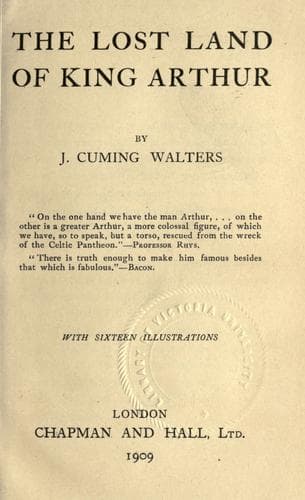
Arthur, King -- Homes and haunts -- England -- Cornwall (County); Cornwall (England : County) -- Antiquities, Celtic
At Camelot, at the vigil of Pentecost, the knights gathered, Sir
Gawaine among them, and his falseness began to bring upon him
retribution. All the seats at the Round Table were filled, save the
Siege Perilous, though the time had now come, “four hundred winters,
and four and fifty being accomplished, after the passion of our Lord
Jesus Christ,” that the place should be no longer vacant. The king
wished, according to custom, to see an adventure before sitting down to
meat, and tidings were brought him of a marvellous stone floating in
the river, and a sword sticking in it. Lancelot warned the knights not
to touch the sword: “Who assayeth for to take that sword, and faileth
of it, he shall receive a wound by that sword.” Nevertheless, Gawaine,
obeying the command of the king, took the sword by the handle, but
failed to move it; and Gawaine next day vowed to set forth upon the
quest of the Grail, the vision of which had appeared unto the assembly
when they returned from “Camelot’s minster.” His quest was unavailing.
Through the streets of Camelot the knights sallied forth, “and there
was weeping of the rich and poor, and the king returned away, and
might not speak for weeping.” Of all who failed, Gawaine failed most
signally. The monk of the abbey where he sought refuge condemned
his wickedness, and the good men at the hermitage of whom he asked
harbour for charity, reproached him with his mischievous life of many
winters, and sternly bade him do penance. If Sir Gawaine redeemed his
reputation as the champion of the injured king, it scarcely sufficed to
atone for the evil he wrought when the days were fair at Camelot.
Public-domain text, read in full here on John Shaqi.
Reviews
Reviews
No reviews yet
Be the first to share your thoughts on this work.
Elsewhere in the archive
Join the Discussion
Join the discussion
Sign in to leave a comment or review.
Sign InorCreate an account