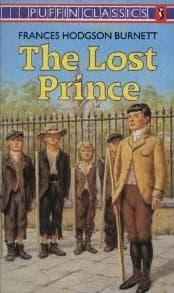
Fathers and sons -- Fiction; People with disabilities -- Fiction; Princes -- Fiction; Refugees -- Fiction
narrow steps going down to a basement kitchen. The back bedroom looked
out on small, sooty, flagged yards, where thin cats quarreled, or sat on
the coping of the brick walls hoping that sometime they might feel the
sun; the front rooms looked over the noisy road, and through their
windows came the roar and rattle of it. It was shabby and cheerless on
the brightest days, and on foggy or rainy ones it was the most forlorn
place in London.
At least that was what one boy thought as he stood near the iron
railings watching the passers-by on the morning on which this story
begins, which was also the morning after he had been brought by his
father to live as a lodger in the back sitting-room of the house No. 7.
He was a boy about twelve years old, his name was Marco Loristan, and he
was the kind of boy people look at a second time when they have looked
at him once. In the first place, he was a very big boy--tall for his
years, and with a particularly strong frame. His shoulders were broad
and his arms and legs were long and powerful. He was quite used to
hearing people say, as they glanced at him, "What a fine, big lad!" And
then they always looked again at his face. It was not an English face
or an American one, and was very dark in coloring. His features were
strong, his black hair grew on his head like a mat, his eyes were large
and deep set, and looked out between thick, straight, black lashes. He
was as un-English a boy as one could imagine, and an observing person
would have been struck at once by a sort of _silent_ look expressed by
his whole face, a look which suggested that he was not a boy who talked
much.
This look was specially noticeable this morning as he stood before the
iron railings. The things he was thinking of were of a kind likely to
bring to the face of a twelve-year-old boy an unboyish expression.
He was thinking of the long, hurried journey he and his father and their
old soldier servant, Lazarus, had made during the last few days--the
journey from Russia. Cramped in a close third-class railway carriage,
they had dashed across the Continent as if something important or
terrible were driving them, and here they were, settled in London as
if they were going to live forever at No. 7 Philibert Place. He knew,
however, that though they might stay a year, it was just as probable
that, in the middle of some night, his father or Lazarus might waken him
from his sleep and say, "Get up--dress yourself quickly. We must go at
once." A few days later, he might be in St. Petersburg, Berlin, Vienna,
or Budapest, huddled away in some poor little house as shabby and
comfortless as No. 7 Philibert Place.
He passed his hand over his forehead as he thought of it and watched the
busses. His strange life and his close association with his father had
made him much older than his years, but he was only a boy, after all,
and the mystery of things sometimes weighed heavily upon him, and set
him to deep wondering.
Public-domain text, read in full here on John Shaqi.
Reviews
Reviews
No reviews yet
Be the first to share your thoughts on this work.
Join the Discussion
Join the discussion
Sign in to leave a comment or review.
Sign InorCreate an account