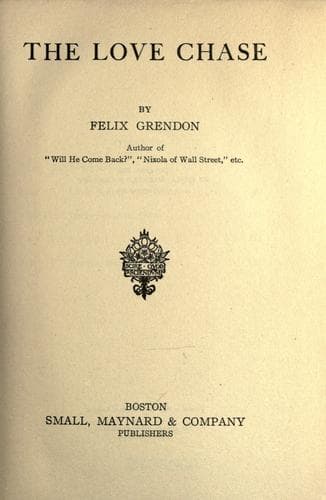
New York (N.Y.) -- Social life and customs -- 20th century -- Fiction
The cause was not far to seek. Janet could pull the trigger that
released and expanded his faculties as no one else had ever been able to
do. In her presence, not merely his better self, but his more
adventurous self, his more aspiring self, his more poetic self, and his
more heroic self—the several Roberts that other people were too dull to
perceive, or too futile, ignorant, or base to cultivate—all these
craving selves came into their own and grew in stature. What was a
previous love affair, what were a dozen previous love affairs, in the
teeth of this miracle? Claude Fontaine! One look into the depth of
Janet’s eyes, and all theories, prejudices, principles, expediencies,
and conflicting emotions went up in smoke.
Meanwhile, Janet’s thoughts had been taking a very different shape.
She did not know that Robert had never seen the long letter to Cornelia
in which she had described her journey with Claude and had given her
European address. Cornelia had withheld this letter from Robert for
reasons scarcely admitted to herself; and what Cornelia did not admit to
herself she was little likely to admit to an interested friend. In fact,
in her letter to Janet and in casual conversations since their recent
reunion, Cornelia had so often allowed it to be inferred that Robert had
had access to the letter, that she ended by making this convenient
inference herself.
Not unnaturally then, Janet reasoned that Robert’s failure to
communicate with her had been deliberate. What dovetailed with this
conclusion was the memory of his dictum on free love. How well she
remembered the relentless words: "I can never have anything to do with
free love or with a woman who has had a free lover. It would defeat my
purpose in life."
His purpose in life! He was the sort of man who took more joy in
finding and working _that_ out than in loving any woman. True, she no
longer concurred in Cornelia’s view that Robert was a fanatic. No. He
just escaped fanaticism by the skin of his teeth. This view explained
both his long silence and his sudden reappearance. That is, she knew
quite well that he had borne her no grudge on account of the past, had
indulged in no theatrical repudiation of her friendship because of her
liaison with Claude. He had simply found it profitless to pursue a
friendship with a woman in her situation. That would be enough to
commit him to silence.
Nor did she take too seriously his assertion that he had made a special
trip to Paris to see her. Why shouldn’t he pay her or Madame Paulette a
visit if the ordinary course of his business brought him almost to their
doorstep? After all, a representative of labor interests could hardly
come to Europe without visiting Paris. Paris, where a lurid,
underground drama of industrial insurrection, half smothered by gold
dust, was going on!
Public-domain text, read in full here on John Shaqi.
Reviews
Reviews
No reviews yet
Be the first to share your thoughts on this work.
Elsewhere in the archive
Join the Discussion
Join the discussion
Sign in to leave a comment or review.
Sign InorCreate an account