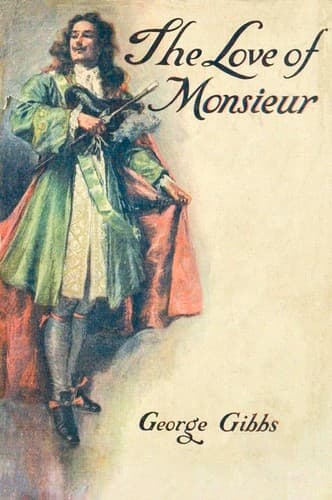
Adventure stories; French -- England -- Fiction; Great Britain -- History -- Charles II, 1660-1685 -- Fiction; Love stories
Mornay’s eyes opened wide with astonishment and interest. He set down
upon the table, untasted, the cup he had raised to his lips, and leaned
intently forward.
“Is it true?” he exclaimed; “and Mistress Barbara has nothing--nothing
at all?” He broke into a hard, dry little laugh. “_Pardieu!_ ’twill
lower her chin, I’m thinking.” Then his face clouded again.
“Go on, monsieur,” he urged, impatiently--“go on.”
“If I can remember it, there’s a bit of family history ye have
not heard, perhaps. Well, ye must know that the Chevalier Bresac,
great-grandfather of this Mistress Clerke, bore a most intolerant
hatred of Spain and the Spanish. His son René inherited this antipathy.
So when he married an English girl and settled in London, he vowed that
if any one of his three daughters married a Spaniard he would cut her
off with a louis.”
He took a long draught of his wine. “Here is where the confession
begins. The eldest daughter disobeyed and married a Spaniard in Paris.
She kept the marriage from her father, and, going to Amiens, gave birth
to a boy. Before she could summon courage to tell old Bresac of her
disobedience, poor cratur, she died.”
“Leaving an heir to the estate.”
“Not so fast. Ye see, not a word of this was known in London; nor
is to-day. At her death the bulk of the fortune went to the second
daughter, who was the mother of this Mistress Barbara. The third
daughter married Heywood’s uncle. Of this there was no issue, but
that’s how the man came to be the guardian.” Cornbury pulled a pipe
from a rack and filled it.
“Now here’s the villainy of the thing. This Spaniard came of gentle
birth, but _au fond_ was a sodden beast. Heywood went to Paris as the
envoy of Wilfred Clerke--Barbara’s father--and, after a shrewd bargain,
bought all the secret papers in evidence of this Spanish marriage.”
“And the real heir?”
“As much alive as you are.”
Monsieur Mornay contemplated the bottom of his bowl.
“_Mille tonnerres!_” he growled. “’Tis the very refinement of perfidy.”
The Irishman drank deep. “A lucky stroke of yours, Mornay, I say. I
would it had been mine.”
“What became of the papers?”
“That’s why Heywood confessed, I suppose. Ye see, he loved his ward,
and wanted Ferrers to destroy them. This he will do, I’m thinking, for
he loves the lady himself.”
“And Mistress Clerke?”
“Hasn’t a notion of it.”
Mornay folded his arms and sat looking at the floor, a strange smile
upon his lips. “_Pardieu!_” he said; “’twould touch her pride--’twould
wring her proud heart to have the heir come back to his own.” The
bitterness of his tone caused Cornbury to look at him in surprise.
“Oh, there’s never a chance of it,” he said. “You see, this Spaniard,
D’Añasco, put the boy upon a ship. Why, what ails ye, man? What is it?
Are ye mad?”
Mornay had seized him by the arm with a grip of iron and leaned forward
with eyes that stared at him like one possessed.
“The name, monsieur?” he said, huskily--“the name--the Spanish name you
said--?”
Public-domain text, read in full here on John Shaqi.
Reviews
Reviews
No reviews yet
Be the first to share your thoughts on this work.
Join the Discussion
Join the discussion
Sign in to leave a comment or review.
Sign InorCreate an account