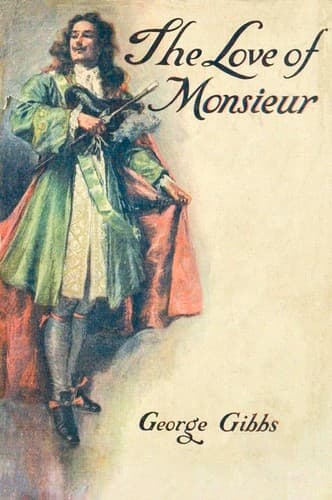
Adventure stories; French -- England -- Fiction; Great Britain -- History -- Charles II, 1660-1685 -- Fiction; Love stories
“Gawd, man, don’t grip me so! You’ve spilled the tobago. ’Twas
D’Añasco, I think, or Damasco, or some such unspeakable thing.”
“Think, man--think!” cried Mornay, passionately. “’Tis a matter of life
and death. Was the name Luis d’Añasco, of Valencia?”
It was Cornbury’s turn to be surprised. He looked at Mornay in
amazement.
“I’ faith, now you mention it, I think it was. But how--”
“And the name of the boy became Ruiz? The ship was the _Castillano_?”
Cornbury’s eyes were wider than ever.
“It was--it was!”
Cornbury paused. Mornay had arisen to his feet and stumbled to the
dormer-window, where he fell rather than leaned against the sill. The
Irishman could see nothing but the upheave of the shoulders and the
twitching of the hands as the man straggled for his self-control.
Cornbury was devoured with curiosity, but with due respect for the
Frenchman’s silence sat smoking vigorously until Mornay chose to speak.
As the Frenchman looked out at the quiet stars across the roof-tops
of London he became calmer, and at last turned around towards the
flickering candles.
“Monsieur,” began Cornbury, with a touch of sympathy.
But Mornay raised his hand in quiet protest. “D’Añasco was my father,
_voilà tout_,” he said slowly. And as the Irishman arose, Mornay
continued:
“I can finish the story, Monsieur Cornbury,” he said, lightly, but with
a depth of meaning in his tone that did not escape the other. “When the
boy Ruiz grew old enough to know, the Spaniard told him that he had no
mother--nor ever had--that he was no-woman’s child. He put him on the
_Castillano_ and sent him out into the great world, without a thought,
without a blessing, without a name--the very shuttle and plaything of
fortune. That child, Cornbury, was myself.”
The Irishman put his arm upon Monsieur Mornay’s shoulder and clasped
him by the hand.
They stood thus a moment until Cornbury broke away and, with a shout
that made the rafters ring, again filled the drinking-bowls upon the
table.
“A health, monsieur!” he cried. “You’ll never drink a better. To the
better fortunes of René d’Añasco, Vicomte de Bresac!”
CHAPTER IV
MONSIEUR WAITS UPON A LADY
Captain Cornbury was no fledgling. He was the younger son, none too
highly esteemed by the elder branch, of a hard-drinking, quick-fighting
stock of ne’er-do-wells. He knew a trick with a sword, and for twenty
years had kept a certain position by his readiness to use it. His last
employment had been in the King’s service as captain in a regiment
of dragoons, but he lived, of a preference, upon his wits. There was
never a game of dice or cards at which he could not hold his own at
luck or skill. Skill at the Fleece Tavern, too, often meant dexterity
in manipulation; and where every man with whom he played took shrewd
advantage of his neighbor there was little to cavil at.
Public-domain text, read in full here on John Shaqi.
Reviews
Reviews
No reviews yet
Be the first to share your thoughts on this work.
Join the Discussion
Join the discussion
Sign in to leave a comment or review.
Sign InorCreate an account