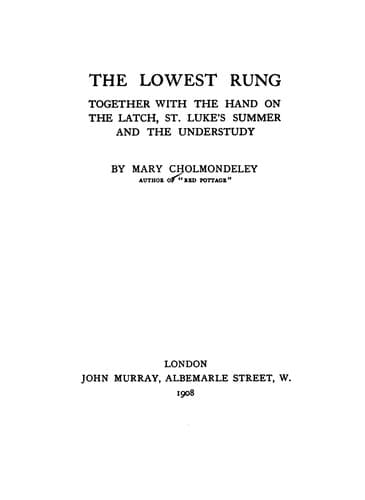
The Lowest Rung: Together with The Hand on the Latch, St. Luke's Summer and The UnderstudyCholmondeley, Mary
General
The Lowest Rung: Together with The Hand on the Latch, St. Luke's Summer and The Understudy
Cholmondeley, Mary
Short stories, English
When the world's asleep,
I awake and weep,
Deeply sighing, say,
"Come, O break of day,
Lead my feet in my beloved's way."
MARGARET L. WOODS.
When first I knew Aunt Emmy I suppose she was about twenty-eight. I was
ten, and I thought her old, but still an agreeable companion, infinitely
pleasanter than her father and her brother, with whom she lived. She was
not my real aunt, but her father was my great-uncle, and I always called
her Aunt Emmy. Great-uncle Thomas and Uncle Tom were persons to be
avoided, stout, heavy, bullet-headed, bull-necked, throat-clearing men,
loud nose-blowers, loud soup-eaters, who reeked of tobacco when it was
my horrid duty to kiss them, and who addressed me in jocular terms when
they remembered my existence, of which I was always loth to remind them.
With these two horrors, whom she loved, Aunt Emmy lived. She was wrapped
up in them. I have actually seen her kiss Uncle Thomas when it was not
necessary, when he was asleep; and she admired Uncle Tom very much too,
though she seldom kissed him, I believe by his wish. He used to say
something about sister's kisses being like cold veal. I don't suppose he
invented that himself. He was always picking up things like that out of
a rose-coloured paper, and firing them off as his own. Uncle Tom was
tall and portly, and a wag out of office hours, with a moustache that,
in spite of all his efforts, would not turn up, but insisted on making a
melancholy inner semicircle just a size smaller than the rubicund circle
of his face. How I hated kindly, vulgar Uncle Tom! I used to pray that
he might die before the holidays. But he never did. I see now that Uncle
Tom was far, far worse than Uncle Thomas, who had had a stroke, and was
a kind of furious invalid who could not speak clearly, or eat anything
except things that were bad for him. But when I was a child, and first
began to spend my holidays in Pembridge Square, I regarded them both
with the same repulsion.
Aunt Emmy was different. I know now that she must have been a remarkably
pretty woman, but I did not notice that at the time. But a faint,
indefinable fragrance seemed to envelop her. I loved to stroke her soft
white hand, and to turn the emerald ring on her third finger, and to
lean against her soft shoulder. Aunt Emmy's cheek was very soft too, and
so was her full, silky hair, which she wore parted all her life, though
it was never the fashion to do so that I can remember, though I am told
it is now the _dernier cri_ among the _debutantes_. Aunt Emmy had a
beautifully shaped head, and the whitest brow and neck that I have ever
seen. And she had a low voice, and was very dignified. I do not think
that she was a very wise woman, or that she had ever wrestled with the
deeper problems of life, or that the mystery of pain had ever caused her
faith to totter. But she was very good to live with. She devoted
herself.
Public-domain text, read in full here on John Shaqi.
Reviews
Reviews
No reviews yet
Be the first to share your thoughts on this work.
Join the Discussion
Join the discussion
Sign in to leave a comment or review.
Sign InorCreate an account