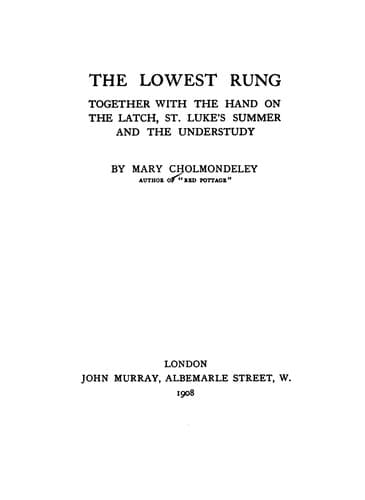
The Lowest Rung: Together with The Hand on the Latch, St. Luke's Summer and The UnderstudyCholmondeley, Mary
General
The Lowest Rung: Together with The Hand on the Latch, St. Luke's Summer and The Understudy
Cholmondeley, Mary
Short stories, English
She never had her own way in anything that I can remember. The house
never represented her. The furniture was leathern and velvet and
stout-looking, the kind of furniture which seems to aim at being more or
less exact moulds of the forms of middle-aged men. The armchairs were
like commodious hip-baths in plush. Aunt Emmy and I were lost in them. I
remember once walking as a child through the wilderness of armchairs at
Maple's and thinking they all looked like Uncle Tom. A good deal of
Utrecht velvet had gone to the upholstering of that house in Pembridge
Square. It was comfortable, airless, flowerless, with gravy-coloured
walls. As I grew older I wondered why it was all so ugly and dreary. But
I found there were less means than I had supposed, and though the
cooking remained excellent, flowers and new chintzes were dispensed with
as unnecessary. Aunt Emmy opened a window surreptitiously now and then,
but Uncle Thomas and Uncle Tom hated draughts, and they did not get off
to sleep so quickly after dinner if the drawing-room had been aired
during the meal. The dining-room windows were never opened at all,
except when Uncle Thomas was too unwell to come in and Uncle Tom was
away.
Many men had wished to marry Aunt Emmy; not only sedentary professional
men in long frock-coats, full to the brim of the best food, like Uncle
Tom; but nice, lean, hungry-looking, open-air men who were majors, or
country squires, or something interesting of that kind, whose clothes
sat well on them, and who drew up in the Row on little skittish,
curveting polo-ponies when Aunt Emmy and I walked there. I once asked
her, after a certain good-looking Major Stoddart had ridden on, why she
did not marry, but she only said reprovingly, with great dignity:
"You don't understand such matters, my dear, or you would know that I
could not possibly leave your Uncle Thomas."
I was silenced. I felt with bitterness that this could not be her whole
reason for celibacy, but that, owing to the purely superficial fact that
my hair was still in a pigtail, she supposed I was unable to comprehend
"lots of things" that I felt I understood perfectly, and on which my
mind was already working with an energy which would have surprised her
had she guessed it.
By this time I worshipped Aunt Emmy, who represented in my somewhat
colourless orphaned existence the beautiful and romantic side of life.
Aunt Emmy looked romantic, and the contrast between her refined, gentle
self-effacement and the commonplace egotism of her two men was of the
glaring nature which appeals to a young girl's imagination.
I never forgot Major Stoddart, and when I was eighteen, and had left
school and was living in Pembridge Square, I had the good fortune to
come in for the remains of a scene between Aunt Emmy and Uncle Tom--the
very day after I had turned up my hair.
Public-domain text, read in full here on John Shaqi.
Reviews
Reviews
No reviews yet
Be the first to share your thoughts on this work.
Join the Discussion
Join the discussion
Sign in to leave a comment or review.
Sign InorCreate an account