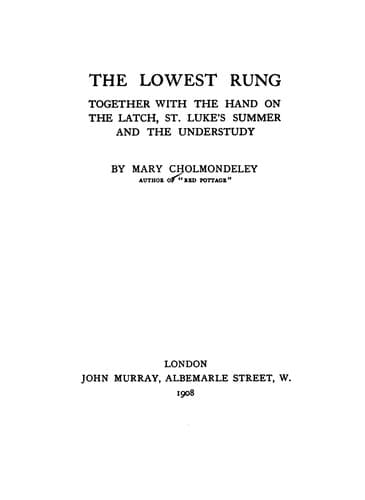
The Lowest Rung: Together with The Hand on the Latch, St. Luke's Summer and The UnderstudyCholmondeley, Mary
General
The Lowest Rung: Together with The Hand on the Latch, St. Luke's Summer and The Understudy
Cholmondeley, Mary
Short stories, English
I am ashamed to say that once again, as in the case of "Aunt Anne," I
endeavoured to exculpate myself in order to pacify two old maiden
ladies. Why is it always the acutely unmarried who are made miserable by
my books? Is it because--odious thought, avaunt!--married persons do not
open them? These two ladies did not, indeed, think that I had been
"paying out" some particular clergyman, as suggested in their favourite
paper, _The Guardian_,[2] but they were shocked by the profanity of the
book. Soon afterwards the Bishop of Stepney (now Bishop of London)
preached on "Red Pottage" in St. Paul's. I sent them a newspaper which
reprinted the sermon _verbatim_, with a note saying that I trusted this
expression of opinion on the part of their idolised preacher might
mitigate their condemnation of the book.
But when have my attempts at making an effect ever come off? My firework
never lights up properly like that of others! It only splutters and goes
out. I received in due course a dignified answer that they had both been
deeply distressed by my information, as it would prevent them ever going
to hear the Bishop of Stepney again.
My own experience, especially as to "Red Pottage" and "Prisoners,"
struck me as so direful, I seemed so peculiarly outside the protection
of Providence, like the celebrated plot of ground on which "no rain nor
no dew never fell," that I consulted several other brother and sister
novelists as to how they had fared in this delicate matter. It is not
for me to reveal the interesting skeletons concealed in cupboards not my
own, but I have almost invariably returned from these interviews
cheered, chuckling, and consoled by the comfortable realisation that
others had writhed on a hotter gridiron than I.
Georges Sand, when she was accused of lampooning a certain _abbe_, said
that to draw one character of that kind one must know a thousand. She
has, I think, put her finger on the truth which is not easy to find--at
least, I never found it until I read those words of hers.
It is necessary to know a very large number of persons of a certain
kind before one can evolve a type. Each he or she contributes a twig,
and the author weaves them into a nest. I have no doubt that I must have
taken such a twig from nearly every clergyman I met who had a _soupcon_
of Mr. Gresley in him.
Public-domain text, read in full here on John Shaqi.
Reviews
Reviews
No reviews yet
Be the first to share your thoughts on this work.
Join the Discussion
Join the discussion
Sign in to leave a comment or review.
Sign InorCreate an account