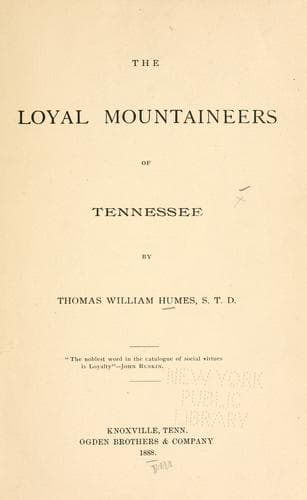
The loyal mountaineers of TennesseeHumes, Thomas William
Philosophy
The loyal mountaineers of Tennessee
Humes, Thomas William
Tennessee, East -- History -- Civil War, 1861-1865
Late in August, to the surprise of civilians, he departed westward
with his troops, crossed the Tennessee River, twenty-nine miles
distant and burned the railway bridge behind him. Something important
had happened or was expected, but the people in their ignorance could
only wonder as to its nature. The retreat left them unprotected from
roving, lawless bands, which the war had spawned. One of these came
into the town at night and despoiled stables of horses. A citizen was
roused from sleep by their near prowling. Hastening to his stable,
he came upon thieves who quickly decamped. They had brought to the
spot a valuable horse just stolen by them from a near stall. They
left it behind in the hurry of flight, but took away the horse whose
owner had alarmed them. Without intending a deed of disinterested
benevolence by interfering with the rogues’ work, he had saved his
neighbor’s property, losing his own. The next day steps were taken
to form companies of armed townsmen for defence against marauders.
Before any thorough organization to that end was made, an unexpected
event occurred.
[Illustration: MAJ. GEN. A. E. BURNSIDE.]
It was the 2nd of September, 1863. A worthy Swiss immigrant of the
town at the beginning of the war espoused the side of “the South”
with all the fervor of his naturally ardent disposition. His friend,
“native and ... to the manner born,” was a decided Union man, and
because of his sentiments, met with various troubles during the
Confederate supremacy at the place, but the true-hearted Switzer was
steadfast in his friendship, at the risk of losing _caste_ with his
own party. In the afternoon of the day, he had concluded a visit
to the Unionist and was walking homeward, when to his astonishment
he saw three men on horseback and in blue uniforms, four hundred
yards distant, galloping towards him as if for life. “Halt!” they
shouted. But not heeding their call, he turned and ran to the room of
his friend, crying out as he entered it, “The Yankees are coming!”
Instantly the family assembled, and as quickly the soldiers in blue
were at the door. They were advance riders of the army under Maj.
Gen. Burnside, and being on the lookout for hostile soldiers in the
town, they had pursued the Switzer in the belief that he was one.
Through an upper window his friend looked out upon the troopers in
the yard, but they saw in the company gathered above, the man whom
they had followed, and immediately one of them, with face white from
excitement, raised his pistol and pointing it upward at the group
exclaimed, “There he is now! Stand out of the way, ladies!” The
native citizen stepped forward and said. “Don’t shoot! I am a Union
man.” The pistol was at once lowered, but the soldiers kept their
ground and must needs be talked with. The Switzer bravely said in
his imperfect English, that he would go down stairs and give himself
up, but his companion would go before, and opening the front door,
Public-domain text, read in full here on John Shaqi.
Reviews
Reviews
No reviews yet
Be the first to share your thoughts on this work.
Elsewhere in the archive
Join the Discussion
Join the discussion
Sign in to leave a comment or review.
Sign InorCreate an account