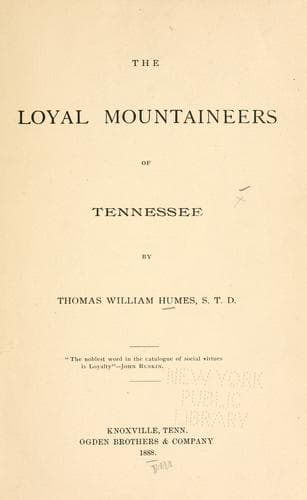
The loyal mountaineers of TennesseeHumes, Thomas William
Philosophy
The loyal mountaineers of Tennessee
Humes, Thomas William
Tennessee, East -- History -- Civil War, 1861-1865
have a firm lodgment in their minds, but lie there unqualified by
knowledge of later occurrences. An anecdote related by John Mitchell
will illustrate.
Scarcely had the United States diplomatic agent just now spoken of,
departed upon an Oriental mission, when the weary Irish patriot
arrived from Australia, in this isolated region. He, too, sought
retirement, and in Tuckaleechee Cove, near the Smoky Mountains,
he found it, with his family. One day some of the neighbors met
together, after the not unfrequent idling custom of men in the
mountains--perhaps for friendly gossip, or to shoot at a mark in
rivalry of skill for a prize. One said:
“Who is this stranger, anyhow? He don’t do nuthin’ only him and his
son go fishin’ and shootin’.”
“O,” another replied, “don’t you know who that is? That’s John
Mitchell, the exile of the British Government.”
“British Government indeed!” said the first speaker. “I thought we
had whipp’d that consarn out long ago.”[8]
One virtue obtains almost universally among the people of East
Tennessee--that of hospitality. It has to some extent diminished in
the valleys, where the inhabitants live as did their ancestors from
plentiful tables and various dishes, but where, since the war ended,
the increase of travel and of commercial intercourse with other parts
of the country have checked generosity and enlarged prudence. Yet it
has lost none of its olden-time proportions in the mountains, where
the table lacks nothing in abundance but a good deal in variety;
where the narrow range of habitual diet affords small opportunity for
skill in cookery, and even that opportunity has not been improved.
There the signs of an advanced civilization--the steam-engine, the
telegraph and the telephone--have never invaded the air with whistle
or wires; but the stranger will be kindly entertained for the night
at little or no charge, and probably when he departs in the morning,
will be cheered on his way by the expressed hope of his host that he
will come again. Not that the landlord thinks money is worthless. For
he and his countrymen are sharp traders. Without adventuring at the
start upon fixed sums, they “beat about the bush” to find out how
much can be had or how little be paid by them, and both buyer and
seller are wide awake to “get the best of the bargain.” They also
know points of law, and are unduly given to litigation in defense of
their real or supposed rights.
Public-domain text, read in full here on John Shaqi.
Reviews
Reviews
No reviews yet
Be the first to share your thoughts on this work.
Join the Discussion
Join the discussion
Sign in to leave a comment or review.
Sign InorCreate an account