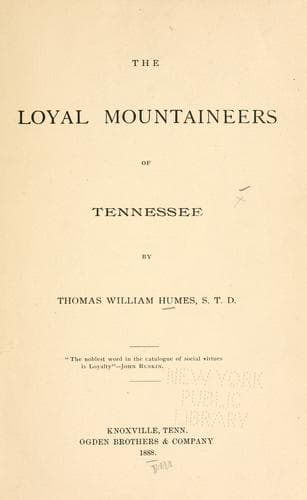
The loyal mountaineers of TennesseeHumes, Thomas William
Philosophy
The loyal mountaineers of Tennessee
Humes, Thomas William
Tennessee, East -- History -- Civil War, 1861-1865
By the pontoon bridge over the river, free access was had by
Burnside’s troops to a portion of the country that was intensely
loyal to the United States, including the southern side of Knox
county and the whole of Sevier County. Some of the people of that
region voluntarily furnished supplies to the besieged; and foraging
parties from the army were sent out, who returned with corn, wheat,
&c. By these means, conducted by Capt. Doughty, spoken of by the
commander-in-chief as “a most excellent officer,” the commissary
department was enabled to issue during the siege after its first few
days, bread made of mixed flour, meal and bran, but then only in half
and quarter rations. Even for this bread, corn on the cob, eaten in
some instances unroasted, had to be substituted several times late in
the siege. Soldiers often ate at once the small piece of bread which
was their whole allowance of nourishment for twenty-four hours. Some
of them, whether from a prudent regard to the returning excesses of
hunger, or to keep up the fiction of three meals a day, divided their
bread into as many parts, which gave them a single mouthful for each
meal. This scanty fare was increased on occasional days by a piece of
fresh pork.
The besiegers wisely thought it important to deprive Burnside of his
supplies from south of the river, and for that purpose to destroy his
bridge. Therefore Confederate soldiers were sent a few miles up the
Tennessee to Boyd’s Ferry--a point near its junction with the French
Broad River, for the construction of a raft, which floating down
would carry away the pontoon. News of this intended feat was conveyed
to headquarters. Townsmen understood that one of the patriotic and
courageous women, who never failed in East Tennessee to serve the
United States upon opportunity, from her home in the country saw the
hewing down of timber and building of the raft, then adroitly she
made her way by night through the Confederate lines with information
to Knoxville, at the risk of liberty and life. In consequence, on
the 22d, at the General’s order, Lieut. Col. Babcock and Capt. Poe
constructed a boom, by stretching an iron cable 1,000 feet long
across the river above the bridge. Begun at 5 P. M., it was finished
at 9 A. M. the next day, and three days later upon renewed alarms,
a second boom was laid, of long timber fastened with chains, on the
surface of the water.
Public-domain text, read in full here on John Shaqi.
Reviews
Reviews
No reviews yet
Be the first to share your thoughts on this work.
Elsewhere in the archive
Join the Discussion
Join the discussion
Sign in to leave a comment or review.
Sign InorCreate an account