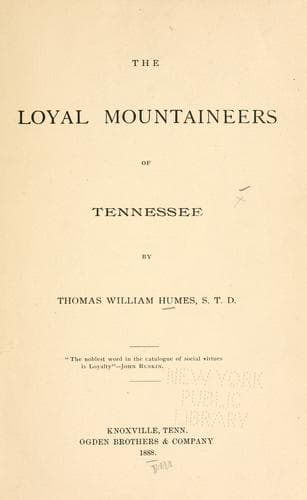
The loyal mountaineers of TennesseeHumes, Thomas William
Philosophy
The loyal mountaineers of Tennessee
Humes, Thomas William
Tennessee, East -- History -- Civil War, 1861-1865
On the 23d, after night had fallen, the Second Division, Ninth
army corps, (Gen. Hartraupt), was attacked and forced to fall back
through that part of the town lying north of the railroad. In this
retreat, houses that were occupied, or in danger of being so, by
Confederate sharp-shooters, were set on fire and burned. For that
purpose the Federal troops made some gallant sorties. Among the
buildings destroyed in the course of the general battling in that
quarter, were dwellings of citizens. In a few instances families were
able to save some of their household goods, to which work officers
and men contributed help when it was possible, but on the night of
the 23d, little or nothing could be done in that way. The railroad
machine shops, numbering eighteen or twenty buildings, and a former
Confederate arsenal containing a large quantity of war material,
shared in the conflagration. The flames that with crackling noise
wrapped many houses in their glowing arms, the billows of smoke
brightly spotted with huge sparks and burning fragments of wood,
the crash of breaking timbers and falling roofs, the explosion of
shells in the arsenal, the firing of guns by the contending armies
which the light of the flames made conspicuous, and their defiant
shoutings at each other in tumultuous anger, altogether combined to
form a remarkable scene. To a lively imagination, it might seem a
panorama of the infernal region--that the roar of guns was the music
of its orchestra, and that evil spirits joined in the _melee_, were
struggling for the mastery in the smoky air above the blazing houses
and fighting men. The conflagration lasted nearly all night.
Next morning the ground from which the Union army had been driven was
recovered by Lieut. Colonel Hawkes of the Twenty-first Massachusetts.
The 24th witnessed a brave sally of the Second Michigan Volunteers
upon the enemy’s advanced rifle pits north of Fort Sanders. They were
at first successful, but not being properly supported, were finally
repulsed, with some loss. On the night of the same day, a pontoon
bridge was thrown across the river below the town, upon which a
portion of Longstreet’s forces passed over, and on the 25th they made
a desperate attempt to seize the heights commanding Knoxville, but
Gen. Shackelford, reinforced by Col. Riley’s brigade, encountered and
defeated them. Failing in that object, they planted a battery upon
a high bluff close to the river’s southern bank, more than a mile
distant from Fort Sanders, but partially commanding it and also the
nearer earthworks on College Hill.
Public-domain text, read in full here on John Shaqi.
Reviews
Reviews
No reviews yet
Be the first to share your thoughts on this work.
Elsewhere in the archive
Join the Discussion
Join the discussion
Sign in to leave a comment or review.
Sign InorCreate an account