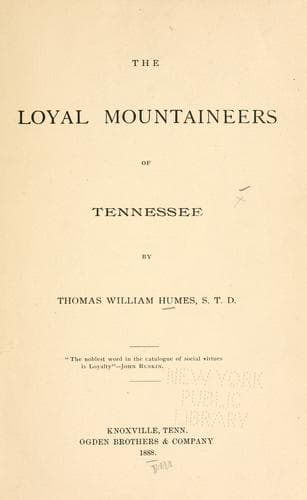
The loyal mountaineers of TennesseeHumes, Thomas William
Philosophy
The loyal mountaineers of Tennessee
Humes, Thomas William
Tennessee, East -- History -- Civil War, 1861-1865
“No more shall the war-cry sever,
Or the winding rivers be red;
They banish our anger forever
When they laurel the graves of our dead!
Under the sod and the dew,
Waiting the judgment day;--
Love and tears for the Blue;
Tears and love for the Gray.”
F. M. FINCH.
Captain Poe, towards the conclusion of his official report to Gen.
Burnside, has given a judicious estimate of the events just narrated.
He says:
“The siege of Knoxville passed into history. If mistakes were made
in the defence, they were covered by the cloak of success. That many
were made in the attack was apparent to us all.[50] That the rebels
made a great error in besieging, is as evident as it now is, that to
accept siege at Knoxville was a great stroke of military policy. The
results of the successful defence are, the defeat of Bragg’s army
and consequent permanent establishment of our forces at Chattanooga,
with tolerably secure lines of communication; the confirmation of our
hold upon East Tennessee; the discomfiture and loss of prestige of
the choicest troops of the enemy’s service.... Is there any man of
that part of the army of the Ohio which was in Knoxville, who would
exchange his nineteen days of service there for any other of the
achievements of his life? Was there a regiment there which will not
put Knoxville on its banners as they now bear Roanoke or Newbern,
Williamsburg or Fair Oaks, Chantilly or South Mountain, Antietam or
Vicksburg?”
The news of Burnside’s successful defence carried joy to Washington
and to all friends of the United States everywhere. The President
issued a proclamation concerning it, in which he spoke of the retreat
of the enemy from before Knoxville “under the circumstances rendering
it probable that the Union forces” could not thereafter “be dislodged
from that important position.” He recommended that “all loyal people”
should “on receipt of this information, assemble at their places of
worship and render special homage and gratitude to Almighty God, for
this great advancement of the National cause.” Congress joyfully
thanked Burnside and his army.
Maj. Gen. John G. Foster, Gen. Burnside’s successor in command of the
Department, was a wholly different type of man, and could not have
sustained rivalry with Burnside in his characteristic lines of life
and conduct. Nor was Foster at all emulous to excel him in that way.
He sought to do his duty after his own fashion, and the fault-finding
to a limited extent, with which his administration met, was largely
due to the comparison civilians would silently make in their minds
between him and his predecessor, to his depreciation, as the lesser
of the two chief lights in their military firmament.
Public-domain text, read in full here on John Shaqi.
Reviews
Reviews
No reviews yet
Be the first to share your thoughts on this work.
Elsewhere in the archive
Join the Discussion
Join the discussion
Sign in to leave a comment or review.
Sign InorCreate an account