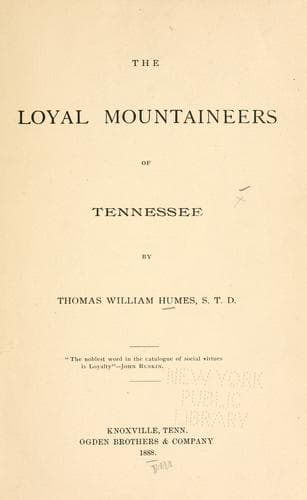
The loyal mountaineers of TennesseeHumes, Thomas William
Philosophy
The loyal mountaineers of Tennessee
Humes, Thomas William
Tennessee, East -- History -- Civil War, 1861-1865
Gen. Sherman, who had arrived in town on December 6, remained only a
few days. His freely active temperament was a subject of observation.
He held himself in no severe restraint, such as a small official’s
sense of dignity would impose. A young Unionist who had been driven
from his home to take refuge in Knoxville, had some skill in portrait
painting, and desired to copy a portrait of the deceased Bishop Otey
of Tennessee that hung in the parlor of the house then occupied
as headquarters. When he applied to Gen. Foster for a loan of the
picture, Gen. Sherman heard the request and springing quickly to his
feet, said:
“Bishop Otey! I knew Bishop Otey. Let’s go and see it.”
When the company had gathered before the likeness, he added--
“I must have that picture. I shall present it to Bishop Otey’s
family.”
The young artist, looking intently at the speaker, said, with great
_sang froid_--
“What is your name?”
“Sherman,” was the reply.
“_General_ Sherman?” he persisted.
“Yes!” said the General: and asked,
“How long do you want the picture?”
Being told, he consented to the loan, and in all probability forgot
entirely that he had made it.[51]
Shortly after Gen. Sherman’s departure from the town, Gen. Grant
visited it, and his reputation for unaffected simplicity of manner,
was confirmed to those who formed his acquaintance. During an
interview with him by a citizen, the conversation turned upon the
siege. The visitor said:
“General, I understand that General Longstreet is loitering in upper
East Tennessee.”
“Yes,” he replied, “I wish now that I had ordered Gen. Sherman to
drive him out.”
This frank admission of a failure to do what ought to have been done,
showed at least, that his head was not turned by the laurels won at
Vicksburg and Mission Ridge, and that he was not morbidly sensitive
about the perfection of his military judgment. If he had then known
the full extent of the ills to the people of upper East Tennessee
which Longstreet’s stay among them would inflict, the omission of the
order to Sherman would have caused him greater regret; for that stay
was prolonged for months. It was instrumental of much annoyance to
the United States troops at various points, and Longstreet’s army,
by living upon the country, contributed largely to bring upon its
inhabitants the great destitution of food, from which they severely
suffered in 1864-’65.
Public-domain text, read in full here on John Shaqi.
Reviews
Reviews
No reviews yet
Be the first to share your thoughts on this work.
Elsewhere in the archive
Join the Discussion
Join the discussion
Sign in to leave a comment or review.
Sign InorCreate an account