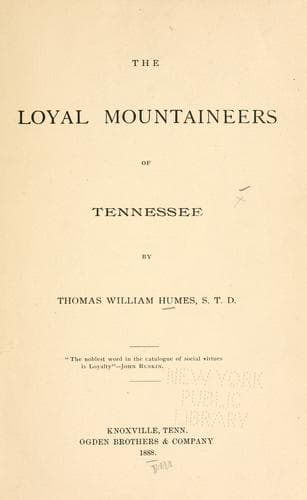
The loyal mountaineers of TennesseeHumes, Thomas William
Philosophy
The loyal mountaineers of Tennessee
Humes, Thomas William
Tennessee, East -- History -- Civil War, 1861-1865
In 1774 the Shawnees and other Indian tribes assailed the western
frontier of Virginia. Lord Dunmore, Governor of that State, called
for volunteers to resist the invasion, and of those enlisted from
southwestern counties of the colony, a regiment under Col. Christian
assembled at New River. To it a company of more than fifty men from
Sullivan and Carter counties (East Tennessee), commanded by Capt.
Evan Shelby, joined themselves, and with it went to Greenbrier, where
Gen. Lewis, commander in chief, assembled his forces. From there
the army marched with difficulty for twenty-five days through the
wilderness, along the rugged banks of the Kanawha River, to Point
Pleasant on the Ohio. Two of Capt. Shelby’s men were instrumental
in preventing the Indians, before day on the 10th of October, from
surprising and probably overthrowing the army of Gen. Lewis. In the
hotly contested battle which immediately followed, some of the same
company dislodged a body of the savages from an important vantage
ground, and thus ensured victory to the Americans. The defeat of
the Indians was so complete that they were subdued into a peace
which lasted for two years. Judge Haywood, in commenting upon the
unexpected discovery of the enemy by men from East Tennessee, to the
salvation of the whole army of the provincials, remarks: “Thus it has
happened that East Tennessee, in the earliest stages of her infancy,
has been called on to contribute all in her power to the common
defense, and seems to have been made much less for herself than for
the protection of her neighbors.”
In the resistance made by the American Colonies to the Government
of Great Britain, these settlers early expressed their sympathy.
Important events touching the welfare of a people may be remotely
separated in space while they are closely related in time. On
the fifth day of September, 1774, when the army of Gen. Lewis at
Greenbrier was about starting on its hard march down the Kanawha
River, to win a victory that would compel the Indians into peace, the
first Continental Congress met in Philadelphia, to deliberate for the
liberty and welfare of the American people. The King of Great Britain
rejected the offers of that Congress. The British Parliament met in
November, and again after the holidays. The twentieth day of January
was the first day of the session in the House of Lords. On the very
same day the men of the settlements beyond the Alleghanies, where
the Watauga and the Holston flow to the Tennessee, united with the
men of the southwestern corner of Virginia in council near Abingdon.
On hearing what Congress had done, they unanimously declared their
adhesion to it. To the Virginia delegates in Congress they wrote:
Public-domain text, read in full here on John Shaqi.
Reviews
Reviews
No reviews yet
Be the first to share your thoughts on this work.
Join the Discussion
Join the discussion
Sign in to leave a comment or review.
Sign InorCreate an account