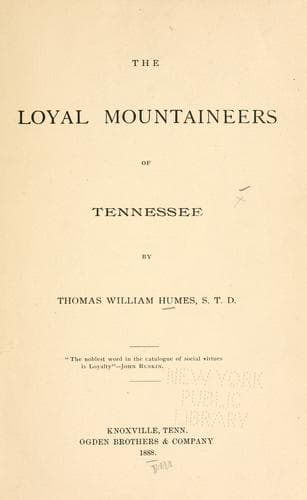
The loyal mountaineers of TennesseeHumes, Thomas William
Philosophy
The loyal mountaineers of Tennessee
Humes, Thomas William
Tennessee, East -- History -- Civil War, 1861-1865
“We explored our uncultivated wilderness, bordering on many nations
of savages, and surrounded by mountains almost inaccessible to any
but these savages. But even to these remote regions the hand of power
hath pursued us, to strip us of that liberty and property with which
God, nature and the rights of humanity have vested us. We are willing
to contribute all in our power, if applied to constitutionally, but
cannot think of submitting our liberty or property to a venal British
Parliament or a corrupt ministry. We are deliberately and resolutely
determined never to surrender any of our inestimable privileges to
any power upon earth, but at the expense of our lives. These are our
real though unpolished sentiments of liberty and loyalty, and in them
we are resolved to live and die.”
The War of the American Revolution began at Lexington and Concord
April 19, 1775 (on the anniversary of which day, eighty-six years
afterwards, was the fight at Baltimore). In describing the swift
travel of the war message from Massachusetts throughout the Colonies,
the historian Bancroft represents it as overleaping bays and rivers
and the Dismal Swamp, passing through pines and palmettoes, and
transcending hills and mountains. “The Blue Ridge took up the
voice and made it heard from one end to the other of the valley of
Virginia.” And westward still: “The Alleghanies, as they listened,
opened their barriers that the ‘loud call’ might pass through to the
hardy riflemen on the Holston, the Watauga and the French Broad,”
who, for some years after the beginning of the war, knew that it
was going on, but the scenes of its battles were far removed from
their secluded homes. The echoes of their wooded hills were now
and then awakened by the notes of the “spirit-stirring drum and
ear-piercing fife,” but never by any martial sounds from conflicts
with arms in the American Revolution. Georgia, in 1779, was brought
into subjection to the King. About a hundred patriots, led by Col.
Clarke, had fled to the mountaineers for refuge, and obtained
helpers in their conflict with the British, in order to renew which,
they returned home. Refugee Whigs had also come from east of the
Alleghanies to the Washington District, into which North Carolina in
1777 organized the Watauga and adjacent settlements. The accounts
given by all these of the persecutions and cruelties inflicted by the
British and Tories, had moved the frontier men to friendly sympathy
with the sufferers, and to slumbering wrath against the oppressors,
and they only needed opportunity to actively join their brethren in
the struggle of the Colonies for independence. The summer of 1780 had
opened, and that opportunity was soon offered.
Public-domain text, read in full here on John Shaqi.
Reviews
Reviews
No reviews yet
Be the first to share your thoughts on this work.
Join the Discussion
Join the discussion
Sign in to leave a comment or review.
Sign InorCreate an account