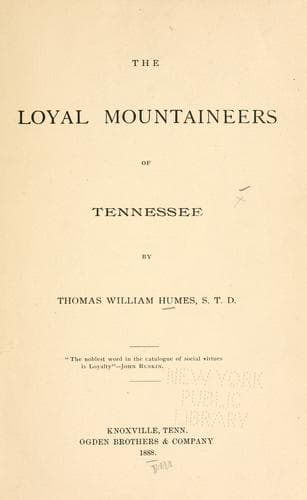
The loyal mountaineers of TennesseeHumes, Thomas William
Philosophy
The loyal mountaineers of Tennessee
Humes, Thomas William
Tennessee, East -- History -- Civil War, 1861-1865
On the 11th of May, Charleston was surrendered by General Lincoln
to Sir Henry Clinton. Shortly afterwards the British power was so
triumphantly extended over South Carolina as to rally to its support
all timid, wavering and disaffected people. North Carolina was in
danger of being conquered. Col. Ferguson, of the British army,
was marching towards it and threatening it with invasion. Col.
Charles McDowell, temporarily chief commander of the Whig forces in
North Carolina, called on Colonels John Sevier and Isaac Shelby,
of Washington District, for help, “as soon as possible,” against
the invader. They promptly responded, and in July, Sevier, with
two hundred mounted riflemen from Washington County, and Shelby,
with an equal number from Sullivan County, joined McDowell’s camp
on Broad River, South Carolina. They did good service in several
conflicts with the enemy, in capturing the fort held by Col. Moore
on the Pacolet River and its garrison, and in winning the battle at
Musgrove’s Mill, where more than two hundred British prisoners were
taken. Upon the heels of this victory came news to McDowell of Gen.
Gates’ defeat at Camden and Sumter’s disaster. This disheartened
the army; it was in a position of danger and could only withdraw. So
great indeed were its apprehensions and sense of inability to hold
its own in the field, that it fairly dissolved. Shelby and Sevier,
with their regiments, returned at once to their distant homes, yet
ready of mind soon to renew the warfare. Not long after, McDowell,
with a company of several hundred men, sought refuge in the same
hospitable region.
Public-domain text, read in full here on John Shaqi.
Reviews
Reviews
No reviews yet
Be the first to share your thoughts on this work.
Join the Discussion
Join the discussion
Sign in to leave a comment or review.
Sign InorCreate an account